Dividend-Focused Strategies: Why Yield Alone Is Not Enough
High yields can be misleading. Learn how disciplined dividend strategies help advisors avoid traps and deliver resilient income.


With headline risk dominating today’s market backdrop, investors have been navigating a choppy environment, and many have turned to dividend‑focused strategies. The appeal is understandable: companies that can pay stable and growing dividends often signal confidence, maturity, and financial strength.
That interest is visible in ETF flows. Dividend‑focused ETFs across the Canadian, U.S., and international markets have amassed more than $47.09 billion, with $11.25 billion of that coming in last year alone.¹
Historically, these strategies have helped investors meet spending needs without being forced to sell underlying holdings, particularly during market drawdowns. In other words, investors can get paid while waiting for the dust to settle. Dividend strategies may also help dampen volatility, supporting total returns by providing an “anchor” when price moves are unpredictable.
Importantly, dividends have been a meaningful component of long‑term equity returns. Since 1926, dividends contributed approximately 31% of the S&P 500’s monthly total return, while capital appreciation contributed 69%² (see Chart 1).
Chart 1: Capital Appreciation & Dividends Contributions to S&P 500’s Total Returns
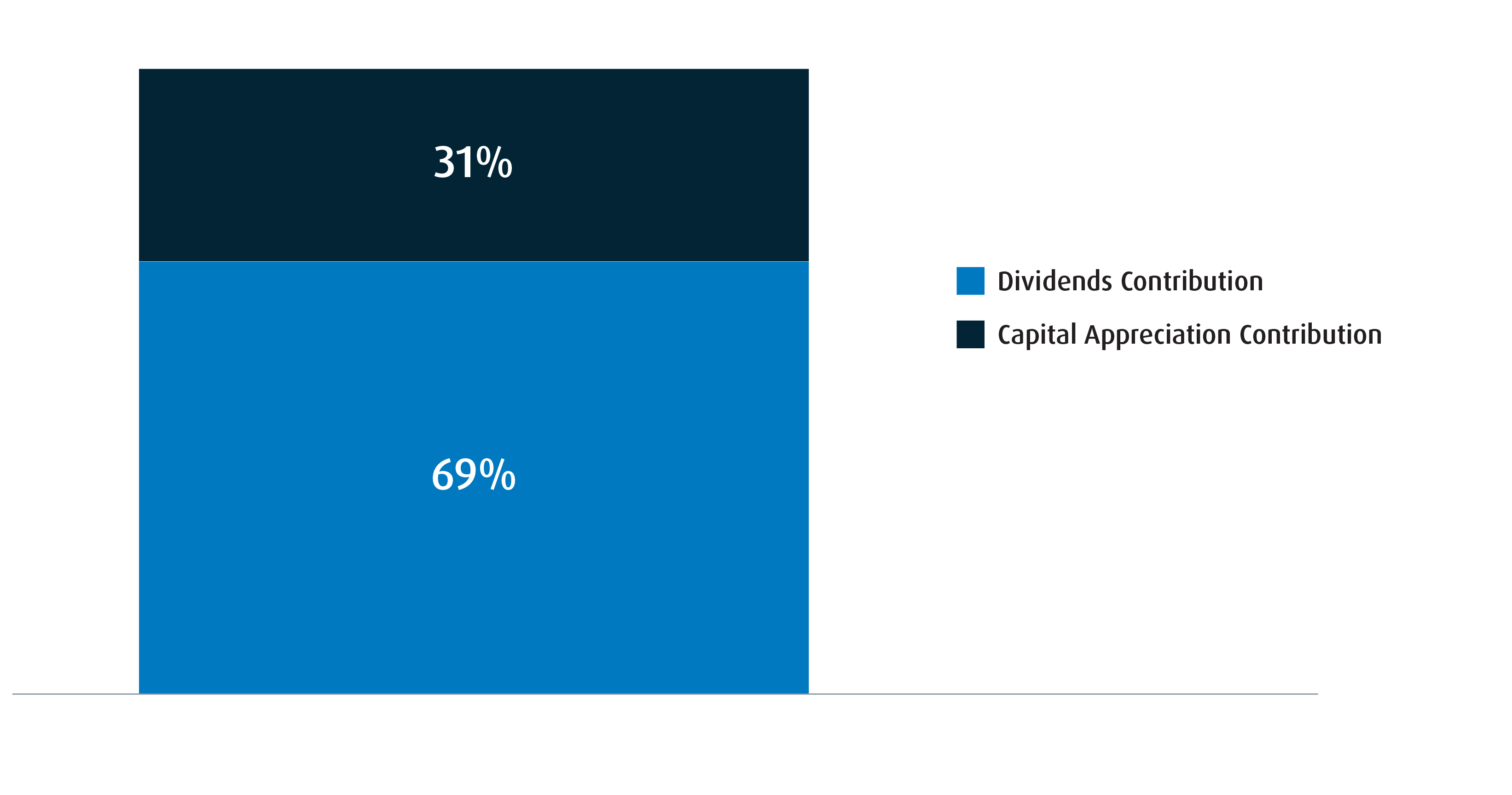
Source: S&P Dow Jones Indices LLC. Data from December 1926 to February 2025. For illustrative purposes. The S&P 500 was launched March 4, 1957. All data prior to index launch date is back-tested hypothetical data.3
Yet yield alone isn’t enough. Investors should look beyond the headline dividend yield, because a higher yield can sometimes reflect deteriorating fundamentals rather than income strength. This is often referred to as a “yield trap”, which is when a stock’s yield becomes artificially elevated because its price has fallen sharply in response to weakening business conditions.
MORE: Read our latest BMO Dividend ETFs Portfolio Manager Market Outlook
So, what should investors look for when evaluating dividend‑focused strategies?
A Rules‑Based Approach to Dividend Strategies
BMO Global Asset Management (BMO GAM) has offered dividend‑focused strategies since 2011. Recognizing how the market environment has evolved, the portfolio management team made a deliberate decision in late 2025 to enhance and modernize the approach, aiming to deliver a more consistent income experience and support resilient wealth outcomes for clients (see Chart 2).
The enhanced framework applies a proprietary four‑step, rules‑based portfolio construction process across BMO GAM’s dividend ETFs. The objective is straightforward, which is to start with quality and fundamentals screen to help avoid deteriorating companies. Dividend screens are then used to boost overall yield (see Chart 3). In practice, this means the investable universe is first assessed for dividend-paying companies with strong underlying fundamentals, attractive valuations, and evidence of market support, prioritizing durability over simply selecting the highest‑yielding names.
Finally, the methodology includes deliberate portfolio construction guardrails designed to reduce the risk of unintended concentration, helping avoid excessive exposure to any single stock and/or sector that could unbalance the portfolio (see Chart 4).
For more information regarding the methodology please see: BMO Dividend ETFs: Portfolio Construction Methodology
Chart 2: From Good to Great – Original vs. Optimized Approach
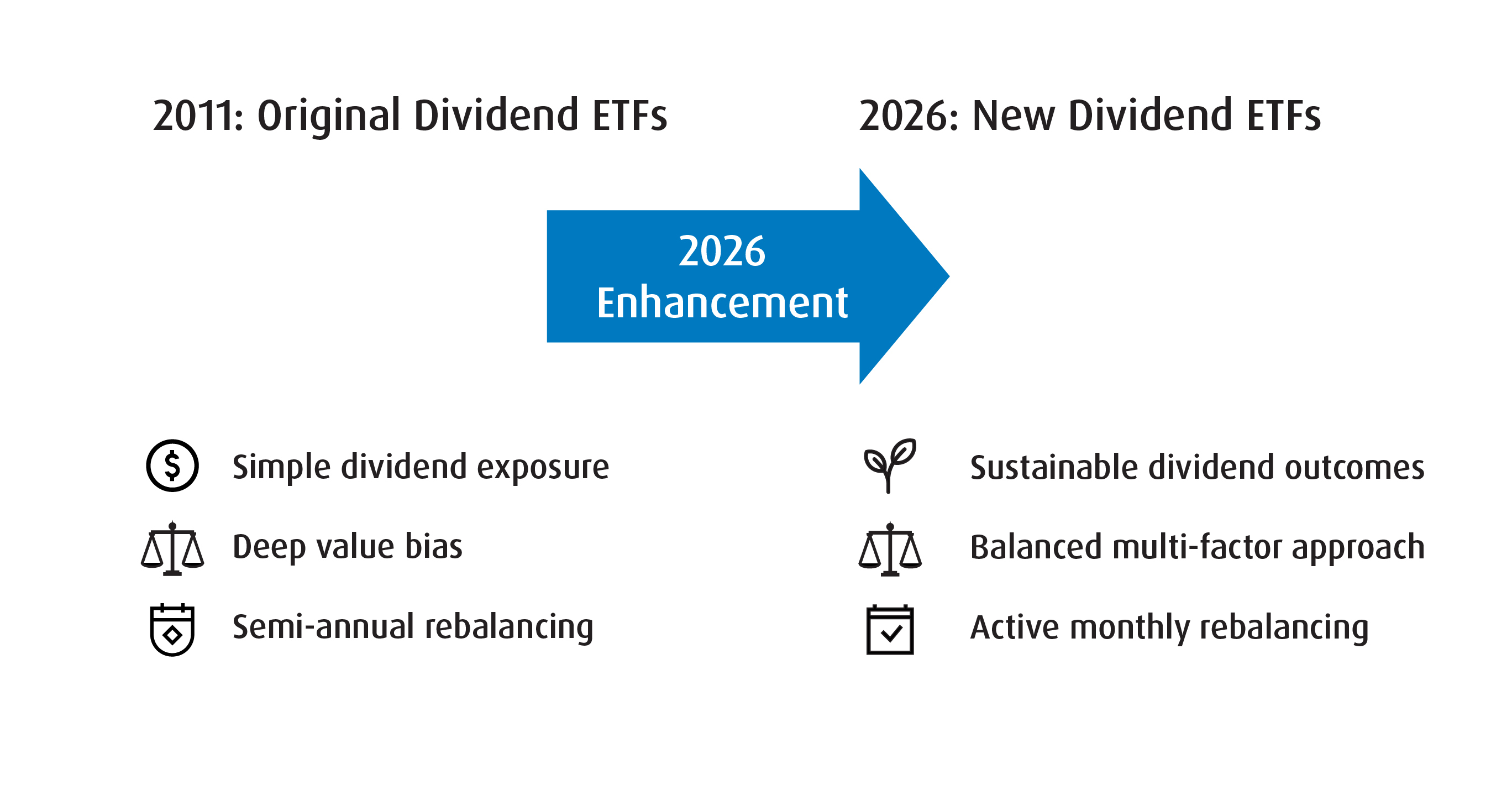
Chart 3: A Disciplined Process Behind Sustainable Income
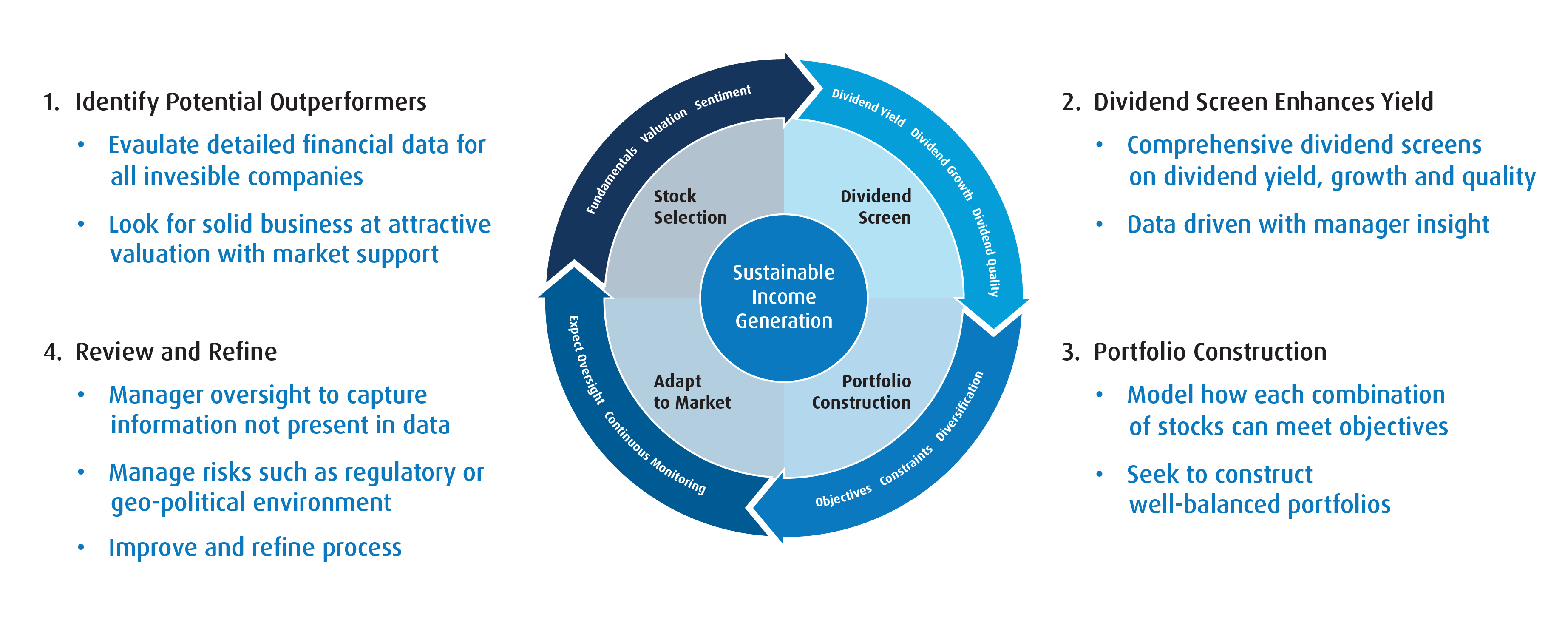
Chart 4: Target Portfolio Construction Controls
Parameter |
Approach |
Universe |
Dividend payers only |
Sector Weights |
Benchmark +/- 5% |
Security Weights |
Benchmark +/- 10% (subject to 10% concentration limit) |
Rebalance |
Monthly – to timely update the portfolio |
Source: BMO Global Asset Management, as of March 31, 2026.
Putting the Methodology into Action: Stock Selection in Practice
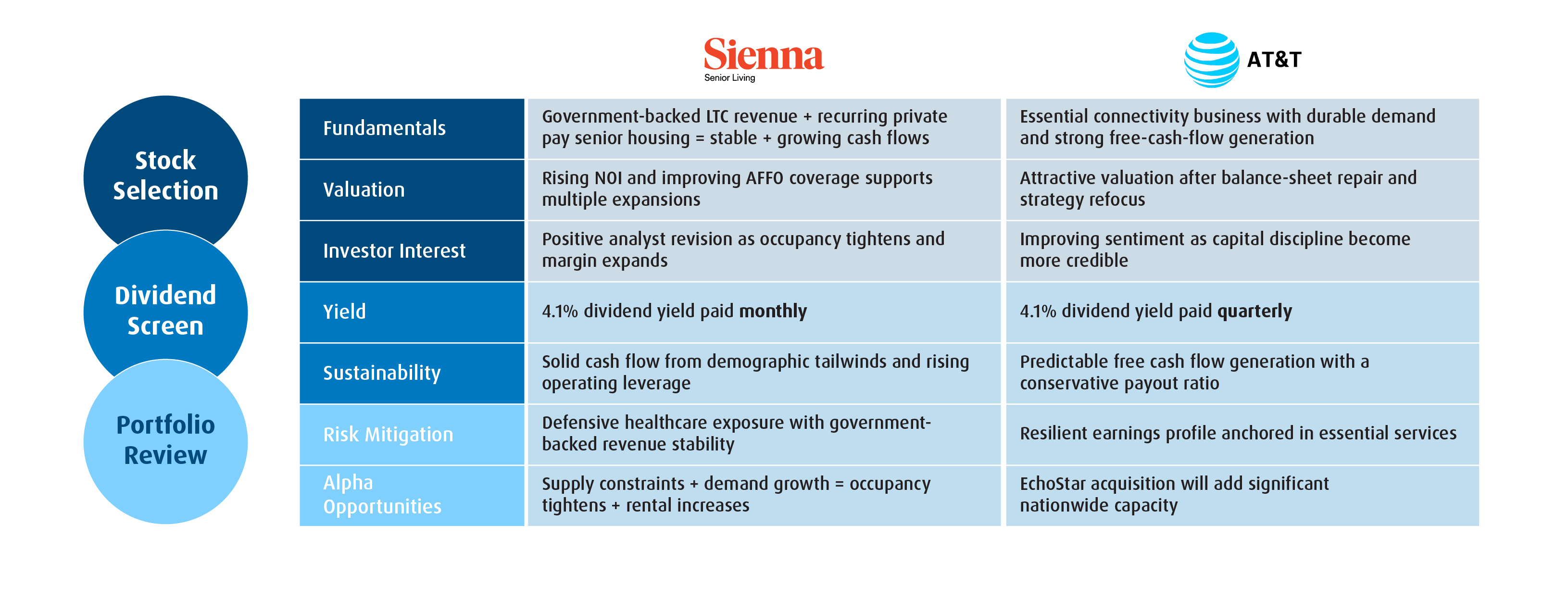
To bring the enhanced methodology to life, Chart 5 highlights two examples of stocks selected through BMO’s rules‑based framework. Sienna Senior Living (Ticker: SIA), a constituent in BMO Canadian Dividend ETF (Ticker: ZDV), and AT&T (Ticker: T) a constituent in BMO US Dividend ETF (ticker: ZDY). Both offer attractive yield at 4.1% while meeting the disciplined, quality-centred stock selection criteria.
Chart 5: Quality Income Grounded in Solid Fundamentals
Resilient Income
To meet the investor interest in dividend-focused strategies across different markets, BMO GAM offers three cost-effective ETFs: ZDV, ZDY, and BMO International Dividend ETF (Ticker: ZDI) which provide exposure to Canadian, U.S., and international dividend paying stocks, respectively. Currency-hedged versions are also available for US (BMO US Dividend Hedged-to-CAD – Ticker: ZUD) and international (BMO International Dividend Hedged-to-CAD – Ticker: ZDH) equity exposures to minimize the impact of currency volatility (see Chart 6).
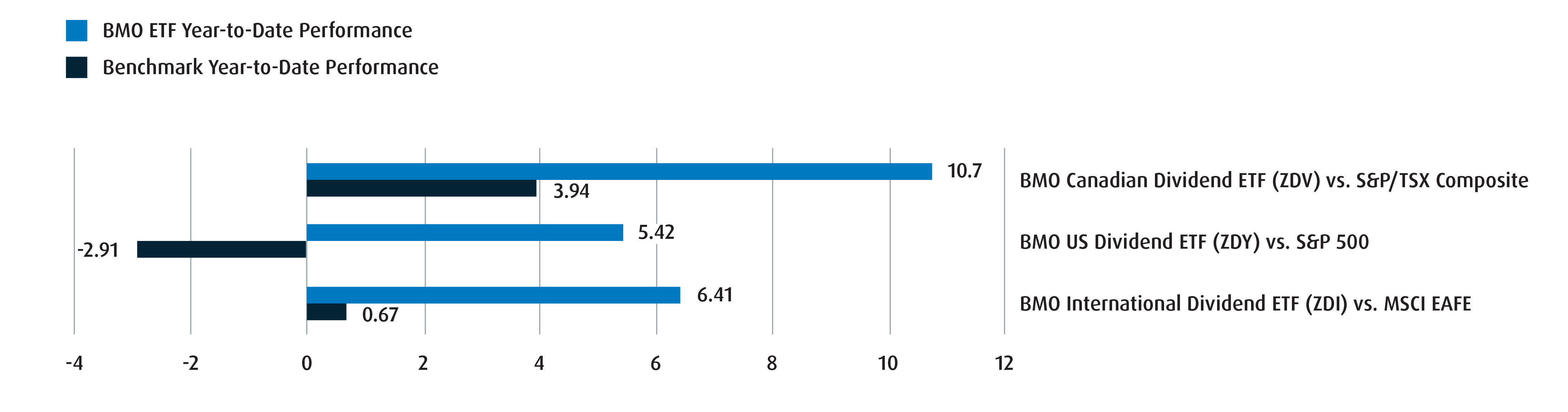
Since introducing the enhancements in late 2025, these ETFs have been designed to deliver resilient income and returns in a volatile market environment. This further illustrates that focusing on high‑quality, cash‑generative companies while avoiding yield traps and speculative growth can be key to delivering strong results. (see Chart 7)
Chart 6
ETF |
Ticker |
Management Fee |
Currency |
0.35% |
CAD |
||
0.30% |
CAD/USD |
||
0.30% |
CAD |
||
0.40% |
CAD |
||
0.40% |
CAD |
Chart 7: Dividend Yields
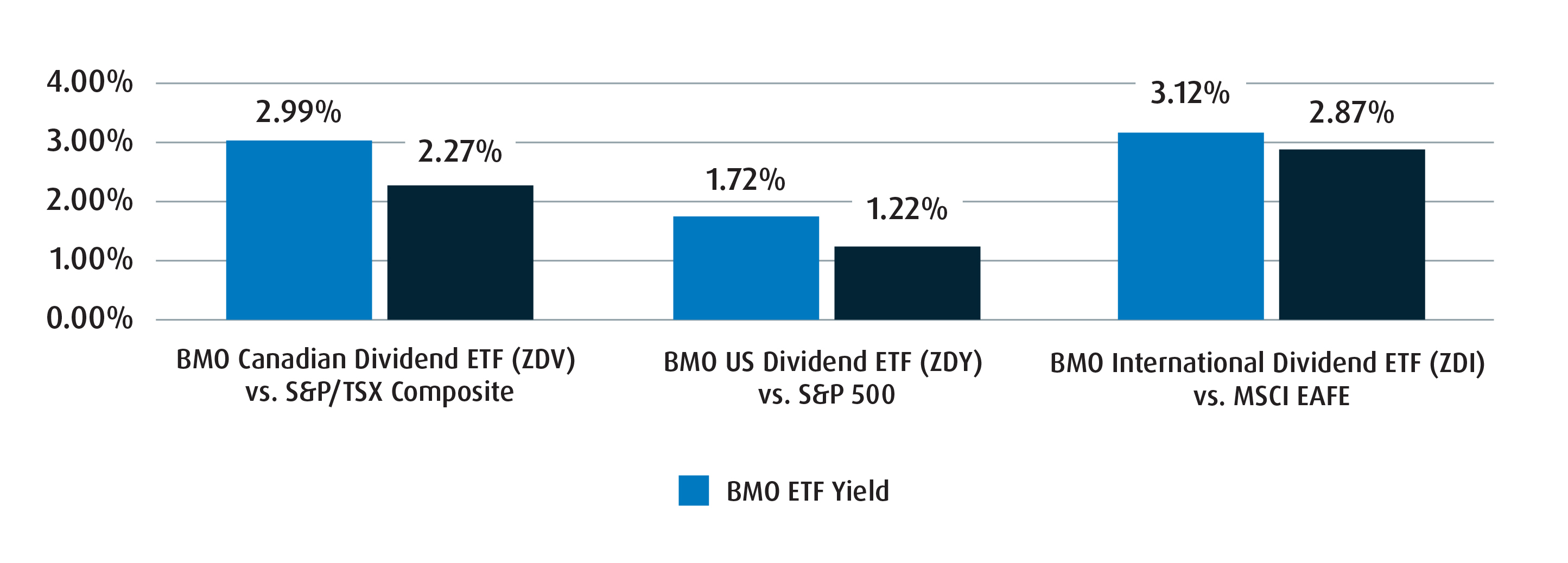
Chart 8: Performance
Standard Performance (%)
Fund name |
Year-to-Date |
1-Month |
3-Month |
6-Month |
1-Year |
3-Year |
5-Year |
10-Year |
Since |
Inception |
10.70% |
-1.09% |
10.70% |
17.77% |
36.92% |
20.25% |
15.66% |
11.76% |
9.64% |
2011-10-21 |
|
6.41% |
-4.96% |
6.41% |
11.70% |
21.72% |
16.94% |
13.33% |
9.39% |
8.45% |
2014-11-05 |
|
5.42% |
-1.68% |
5.42% |
6.65% |
13.98% |
15.55% |
12.62% |
10.76% |
13.23% |
2013-03-19 |
|
6.53% |
-4.73% |
6.53% |
14.43% |
22.05% |
16.31% |
13.78% |
10.38% |
9.71% |
2015-09-02 |
|
3.68% |
-3.59% |
3.68% |
5.83% |
15.32% |
12.90% |
9.25% |
8.85% |
9.73% |
2013-03-19 |
Bloomberg/BMO Global Asset Management, as of March 31, 2026. Index returns do not reflect transactions costs or the deduction of other fees and expenses and it is not possible to invest directly in an Index. Past performance is not indicative of future results.
1 Morningstar Direct. Data is as of March 31, 2026. Canadian Dividend and Income Equity and U.S. Dividend and Income Equity Morningstar categories were used for Canadian and U.S. equity ETFs’ AUM and flows, while Morningstar’s International Equity category was used for dividend focused international equity ETFs’ AUM and flows.
Morningstar Direct data as of March 31, 2026. Canadian and U.S. Dividend & Income Equity categories were used for Canadian and U.S. Equity ETF AUM and flows, while International Equity category was used for dividend-focused international Equity ETFs.
2 S&P DJI, S&P 500 Dividend Aristocrats: The Importance of Stable Dividend Income.
3 Data, not actual performance, and is based on the index methodology in effect on the index launch date. However, when creating back-tested history for periods of market anomalies or other periods that do not reflect the general current market environment, index methodology rules may be relaxed to capture a large enough universe of securities to simulate the target market the index is designed to measure or strategy the index is designed to capture. For example, market capitalization and liquidity thresholds may be reduced; history is based on the index constituents that meet the custody element as of the Launch Date. Also, the treatment of corporate actions in back-tested performance may differ from treatment for live indices due to limitations in replicating index management decisions. Complete index methodology details are available at www.spglobal.com/spdji. Back-tested performance reflects application of an index methodology and selection of index constituents with the benefit of hindsight and knowledge of factors that may have positively affected its performance, cannot account for all financial risk that may affect results and may be considered to reflect survivor/look ahead bias. Actual returns may differ significantly from, and be lower than, back-tested returns. Past performance is not an indication or guarantee of future results.
Disclaimers
Advisor Use Only.
This article is for information purposes. The information contained herein is not, and should not be construed as, investment, tax or legal advice to any party. Particular investments and/or trading strategies should be evaluated relative to the individual’s investment objectives and professional advice should be obtained with respect to any circumstance.
The viewpoints expressed represent an assessment of the markets at the time of publication. Those views are subject to change without notice at any time. The information provided herein does not constitute a solicitation of an offer to buy, or an offer to sell securities nor should the information be relied upon as investment advice. Past performance is no guarantee of future results. This communication is intended for informational purposes only.
Cash distributions, if any, on units of a BMO ETF (other than accumulating units or units subject to a distribution reinvestment plan) are expected to be paid primarily out of dividends or distributions, and other income or gains, received by the BMO ETF less the expenses of the BMO ETF, but may also consist of non-taxable amounts including returns of capital, which may be paid in the manager’s sole discretion. To the extent that the expenses of a BMO ETF exceed the income generated by such BMO ETF in any given month, quarter, or year, as the case may be, it is not expected that a monthly, quarterly, or annual distribution will be paid. Distributions, if any, in respect of the accumulating units of BMO Short Corporate Bond Index ETF, BMO Short Federal Bond Index ETF, BMO Short Provincial Bond Index ETF, BMO Ultra Short-Term Bond ETF and BMO Ultra Short-Term US Bond ETF will be automatically reinvested in additional accumulating units of the applicable BMO ETF. Following each distribution, the number of accumulating units of the applicable BMO ETF will be immediately consolidated so that the number of outstanding accumulating units of the applicable BMO ETF will be the same as the number of outstanding accumulating units before the distribution. Non-resident unitholders may have the number of securities reduced due to withholding tax. Certain BMO ETFs have adopted a distribution reinvestment plan, which provides that a unitholder may elect to automatically reinvest all cash distributions paid on units held by that unitholder in additional units of the applicable BMO ETF in accordance with the terms of the distribution reinvestment plan. For further information, see the distribution policy in the BMO ETFs’ prospectus.
Distribution yields are calculated by using the most recent regular distribution, or expected distribution, (which may be based on income, dividends, return of capital, and option premiums, as applicable) and excluding additional year end distributions, and special reinvested distributions annualized for frequency, divided by current net asset value (NAV). The yield calculation does not include reinvested distributions.
Distributions are not guaranteed, may fluctuate and are subject to change and/or elimination. Distribution rates may change without notice (up or down) depending on market conditions and NAV fluctuations. The payment of distributions should not be confused with the BMO ETF’s performance, rate of return or yield. If distributions paid by a BMO ETF are greater than the performance of the investment fund, your original investment will shrink. Distributions paid as a result of capital gains realized by a BMO ETF, and income and dividends earned by a BMO ETF, are taxable in your hands in the year they are paid. Your adjusted cost base will be reduced by the amount of any returns of capital. If your adjusted cost base goes below zero, you will have to pay capital gains tax on the amount below zero.
Commissions, management fees and expenses all may be associated with investments in exchange-traded funds. Please read the ETF Facts or prospectus of the BMO ETFs before investing. The indicated rates of return are the historical annual compounded total returns including changes in unit value and reinvestment of all dividends or distributions and do not take into account sales, redemption, distribution or optional charges or income taxes payable by any unitholder that would have reduced returns. Exchange-traded funds are not guaranteed, their values change frequently and past performance may not be repeated.
For a summary of the risks of an investment in the BMO ETFs, please see the specific risks set out in the BMO ETF’s prospectus. BMO ETFs trade like stocks, fluctuate in market value and may trade at a discount to their net asset value, which may increase the risk of loss. Distributions are not guaranteed and are subject to change and/or elimination.
BMO ETFs are managed by BMO Asset Management Inc., an investment fund manager, a portfolio manager, and a separate legal entity from Bank of Montreal.
BMO Global Asset Management is a brand name under which BMO Asset Management Inc. and BMO Investments Inc. operate.
“BMO (M-bar roundel symbol)” is a registered trademark of Bank of Montreal, used under licence.
This article may contain links to other sites that BMO Global Asset Management (BMO GAM) does not own or operate. Any content from or links to a third-party website are not reviewed or endorsed by BMO GAM. Investors use any external websites or third-party content at their own risk. Accordingly, BMO GAM disclaims any responsibility for them.