The Case for Asset-Backed Securities in Investor Portfolios
ABS can offer a more granular underwriting framework than traditional corporate lending…


Learn more about BMO Asset-Backed Securities ETF
For many investors, fixed income has traditionally meant government bonds, investment grade corporate credit, high yield bonds or bank loans. Those markets remain important, but they do not represent the full opportunity set available to investors seeking income, diversification, and differentiated sources of return. Asset-backed securities, or ABS, and the broader category of asset-based finance, or ABF, offer exposure to a different type of credit risk: lending supported by pools of financial or hard assets that generate contractual cash flows.
In simple terms, ABS are securities backed by assets such as auto loans, credit card receivables, equipment leases, student loans, consumer loans, residential mortgages or other pools of receivables. ABF is the broader term, often used to describe both public securitized credit and private lending secured by income producing assets.
The appeal is straightforward: instead of relying only on the general creditworthiness of a company, investors are lending against identifiable collateral and expected cash flows. That distinction matters. In corporate credit, repayment often depends on management experience and execution capabilities, EBITDA growth, refinancing conditions, enterprise value, sponsor behaviour, and the competitive environment. In asset-backed finance, repayment is more linked to the performance of underlying assets. These asset pools are often well diversified across thousands of borrowers, contracts, leases, receivables or loans, creating a very different risk profile from a single corporate issuer.
A Large and Growing Opportunity
Asset-backed finance is not a niche market. It is embedded in the real economy. Consumers finance cars, homes, tuition, credit card purchases, solar panels, and home improvements. Companies finance aircrafts, equipment, data infrastructure, receivables, music royalties, fund interests and other asset pools. Each of these cash flowing assets can become part of an asset-backed financing structure.
Figure 1: Asset-Backed Securities Exposure Across the Real Economy
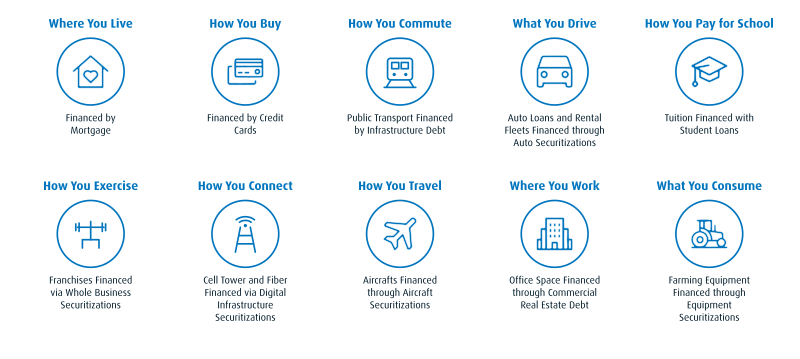
U.S. consumer and commercial ABS is a sizable market with high growth potential, with an estimated outstanding market value exceeding US$800 billion as of June 2026.1
So far in 2026, U.S. consumer and commercial ABS supply has reached US$243 billion, an ~10% increase over the same YTD period in 2025,[1] with average weekly secondary trading volume exceeding US$4 billion.2
Strong investor demand is also being reinforced by a structural shift in credit markets. Banks have become more selective in certain balance sheet intensive activities because of regulation, capital requirements, deposit pressures, and risk management. That has created additional capacity for private lenders, asset managers, insurers, and structured credit investors to provide much needed capital.
Diversification Beyond Corporate Credit
A core benefit of ABS and ABF is portfolio diversification. Many investors already own substantial exposure to corporate risk through equities, corporate bonds, high-yield funds, bank loans, private credit, and even parts of real estate credit. ABS and ABF may offer investors access to different sources of risk and return than traditional corporate credit by accessing different borrowers, collateral types, and repayment patterns.
A portfolio of ABS investments provides investors access to a multitude of different consumer and commercial lending and leasing segments, with different sensitivities to macroeconomic and geopolitical factors relative to corporate credit and equity exposures. For example, consumer loan performance is more influenced by idiosyncratic factors, including unique borrower circumstances and behaviours (e.g., employment, household balance sheets, and spending patterns), whereas the factors that drive performance on equipment and digital infrastructure leases differ substantially, which can help diversity portfolios.
ABS investments add a unique credit segment with different economic drivers and collateral protection, which can complement corporate lending because it introduces differentiated borrower bases, economic risk factors, and contractual cash flows.
Income Supported by Contractual Cash Flows
The second benefit is income, as ABS have historically demonstrated higher spreads and yields at times relative to similarly rated low duration corporate bonds.3 Further, ABS are typically built around assets that have historically demonstrated contractual recurring payment. For example, auto loans amortize (pay down gradually over time), equipment leases produce scheduled lease payments and mortgage loans generate scheduled principal and interest payments. Many ABS transactions are structured to capture these stable cash flows and allocate them through a well governed priority of payments structure.
This cash flow orientation can be attractive in an environment where investors want income but are wary of taking on too much corporate credit beta or equity-like risk. Rather than lending solely against a company’s future profitability, investors can underwrite the expected behaviour of a pool of homogenous assets, which often have reliable historical performance track records through multiple economic environments. The quality of the collateral, seasoning of the loans, borrower diversification, credit enhancement, servicing quality, and structural protections all become central to the investment case.
For investors, this means ABS is not one single asset class, but rather it is a toolkit of structures that can be designed around the cash flow profile of the collateral.
Structural Protection and Credit Enhancement
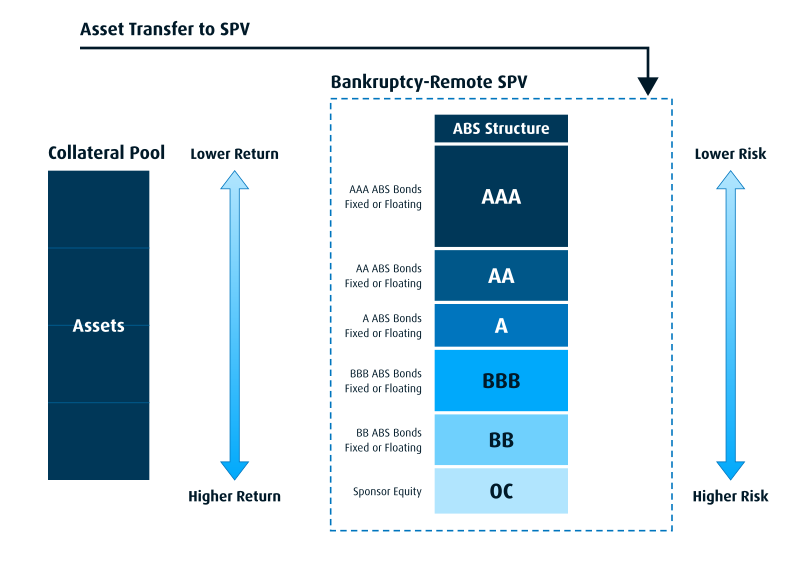
The third benefit is structural protection. ABS transactions are organized into tranches, where senior investors receive priority in the cash flow waterfall and benefit from loss absorption support (subordination) beneath them (See Figure 2). Other forms of investor protections include overcollateralization, excess spread, reserve accounts, performance triggers, amortization, and eligibility criteria for collateral pools.
This structure allows investors to choose the part of the risk spectrum that best matches their objectives and unique circumstances. Conservative investors may prefer senior, investment-grade tranches with meaningful credit support, while Investors with higher return targets may favour more junior tranches with higher levels risk in exchange for a higher expected return. Lastly, ABS have historically demonstrated lower default rates4 and lower levels of volatility5 relative to corporate credit.
The key point is that ABS can offer a more granular underwriting framework than traditional corporate lending. Instead of asking only whether a company can repay a bond, investors can assess thousands of underlying receivables, historical loss curves, collateral values, prepayment rates, delinquency trends, servicer performance and structural protections.
Figure 2: Illustrative Example of an ABS Structure
Understanding ABS Return Drivers
The fourth benefit is the potential for attractive risk-adjusted returns. ABS can pay a little extra yield (spread premium) because they are more complex, less familiar, and often require specialized underwriting. Moreover, complexity is not automatically a bad thing, as many of the structural nuances are designed specifically to protect ABS bond investors. In public ABS, that extra yield may compensate investors for liquidity, structure, collateral type, and market technicals.
Resilience Through Collateral and Self-Amortization
Another advantage of many types of ABS investments is self-amortization, as the loan balance is gradually reduced over time, mitigating refinancing risk and the reliance on capital markets that comes with a bullet repayment at maturity, as is often the case in traditional corporate bonds.
This feature can be particularly valuable during periods of market stress. A corporate borrower may need to refinance debt at exactly the wrong time. By contrast, an amortizing pool of loans may continue to return principal as borrowers make payments. Of course, losses can still rise during downturns, and prepayment behaviour can change, but the structure of the asset pool can create a different repayment path than a single corporate obligation.
ABS Risks That Investors Should Be Mindful of
A credible case for ABS must also acknowledge the risks. These investments require specialized skills in the areas of collateral assessment, understanding different structures, evaluating the asset servicer capabilities, documentation, and liquidity.
As investing comes with risks, investors should be familiar with the key risks inherent in ABS investing. Asset-backed securities are subject to risks including credit risk, liquidity risk, prepayment risk, extension risk and valuation risk. Performance and principal are not guaranteed, and losses may occur. Historical characteristics of ABS sectors may not be indicative of future results.
Sources
1 J.P. Morgan U.S. ABS Research published on August 14, 2026. Estimated U.S. consumer and commercial ABS outstanding as of June 2026 according to J.P. Morgan is ~$831 billion.
2 J.P. Morgan U.S. ABS Research, FINRA TRACE, and Bloomberg as of August 14, 2026. U.S. consumer and commercial ABS supply is ~$243 billion YTD in 2026 as of August 14, 2026, compared to US$219 billion in consumer and commercial ABS supply in the same YTD period of 2025, according to J.P. Morgan. Average weekly secondary market trading volume of U.S. consumer and commercial ABS totalled ~$4.13 billion YTD 2026, according to the J.P. Morgan research.
3 ABS yields and spreads are based on the average constituent mid YTM and mid OAS spread of the ICE BofA US Fixed Rate Asset Backed Securities Index and the ICE BofA AA-BBB US Asset Backed Securities Index as of April 2, 2026, and corporate bond yields and spreads are based on the average constituent mid YTM and mid OAS spread of the Bloomberg US Corporate Bond Index as of April 2, 2026. Additional supporting data: BofA Global Research ABS Weekly as of August 14, 2026, which includes a 2-year trend from August 2024 to August 2026, showing 1+ year AAA-A ABS spreads have remained higher than 1-5 years AAA-A corporate bond spreads during the observation period. Historical characteristics may not be indicative of future results and will vary by ABS sector, credit quality and market environment.
4 Long term default statistics cover the period from 1990 to 2024 and are sourced from the Fitch Ratings Structured Finance 2024 Transition and Default Study as of December 2024 and published in June 2025. The Fitch study highlights that ABS have historically demonstrated lower annual default rates compared to corporate credit. ABS defaults are represented by Impairments including downgrades to CC, C, and D, whereas corporate defaults typically ignore CC and C downgrades. The statistics represent overall figures across all rating categories. Historical characteristics may not be indicative of future results and will vary by ABS sector, credit quality and market environment.
5 Volatility claims based on a comparison of the annualized standard deviation of the ICE BofA AA-BBB Asset Backed Securities Index (R0A2) and Bloomberg US Corporate Bond Index (LUACTRUU) over the 10-year period from March 2016 to March 2026. Historical characteristics may not be indicative of future results and will vary by ABS sector, credit quality and market environment.
Disclaimers
This material is intended for information purposes only. The information provided herein does not constitute a solicitation of an offer to buy, or an offer to sell securities, nor should the information be relied upon as investment, tax, or legal advice to any party. Particular investments and/or trading strategies should be evaluated relative to the individual’s investment objectives and professional advice should be obtained with respect to any circumstance. Past performance is no guarantee of future results.
The views contained herein represent those of the author at the time of publication and are subject to change without notice at any time. Any statement that necessarily depends on future events may be a forward-looking statement. Forward-looking statements are not guarantees of performance. They involve risks, uncertainties and assumptions. Although such statements are based on assumptions that are believed to be reasonable, there can be no assurance that actual results will not differ materially from expectations. Investors are cautioned not to rely unduly on any forward-looking statements. In connection with any forward-looking statements, investors should carefully consider the areas of risk described in the most recent simplified prospectus.
BMO Global Asset Management is a brand name under which BMO Asset Management Inc. and BMO Investments Inc. operate.
“BMO (M-bar roundel symbol)” is a registered trademark of Bank of Montreal, used under licence.