Weekly Basis Points - Four Market Themes for Q3 Earnings Season
October 19, 2026
- In the US, Q3 earnings season is underway. With expectations already elevated, investors will be looking for signals on the durability of earnings growth into 2027.
- Investors are shifting their focus from the scale of AI investment to evidence that investments are translating into sustained profitability and monetization.
- We remain bullish on risk, but the combination of elevated valuations and higher bond yields supports a tilt toward quality and downside protection.
In the US, Q3 earnings season is underway with equities once again sitting near record highs. As is usual, major US banks have kicked off reporting season. The early results have been broadly positive, with financials reporting earnings above expectations despite more modest sales surprises. Yet the muted share-price response suggests that solid results are not necessarily enough to impress investors.
The street is expecting another solid quarter of earnings growth, but with expectations already elevated, the focus is likely to shift quickly from backward-looking results to forward guidance. More than the beats and misses, investors will be looking for signals on the durability of earnings growth into 2027. Here are four themes we will be watching closely.
i.) Will strong earnings be enough?
The S&P 500 has continued to climb, largely because earnings expectations have moved steadily higher. However, the focus is pivoting towards whether companies can beat earnings expectations by enough to justify current valuations. Companies may need to deliver strong results alongside upward revisions to full-year guidance to be rewarded by investors.
This dynamic could become especially important in sectors where expectations have become stretched. Management commentary around order books, customer demand, and pricing power may ultimately matter more than the quarterly numbers themselves.
ii.) The AI trade enters its next phase
For much of the past two years, earnings calls have been dominated by announcements of record capital expenditures, data centre investments, and AI infrastructure buildouts. This quarter, investors will likely demand greater evidence that those investments are translating into sustained profitability and monetization.
The spotlight will once again fall on mega-cap technology companies, particularly cloud providers, semiconductor firms, and enterprise software companies. Markets have become less tolerant of escalating capital expenditure plans if management teams cannot demonstrate a credible path to returns on invested capital.
Importantly, commentary from companies outside the technology sector may be just as revealing. Evidence that AI is improving productivity, reducing labour costs, or enhancing margins across industries would reinforce the broader bullish investment case. However, the risks are growing more asymmetric. Last week’s price action implies that investors are growing more cautious about additional capex given that it’s primarily funded via debt issuance.
iii.) Higher yields are back in focus
The rise in treasury yields during the past few months has important implications across sectors. Higher borrowing costs create a more challenging environment for highly leveraged businesses and sectors with long-duration cash flows. Real estate, technology, utilities, telecommunications, and other yield-sensitive industries may face greater scrutiny as investors reassess financing costs and balance sheet resilience.
Conversely, financial institutions could benefit from a higher-rate backdrop, particularly if elevated yields support net interest income. However, investors will also want clarity on loan growth, credit quality, and the potential impact of a slower economic environment. More broadly, management commentary on demand sensitivity to higher rates could offer early signals regarding how restrictive financial conditions are becoming for consumers and businesses alike.
iv.) Is the US consumer finally slowing?
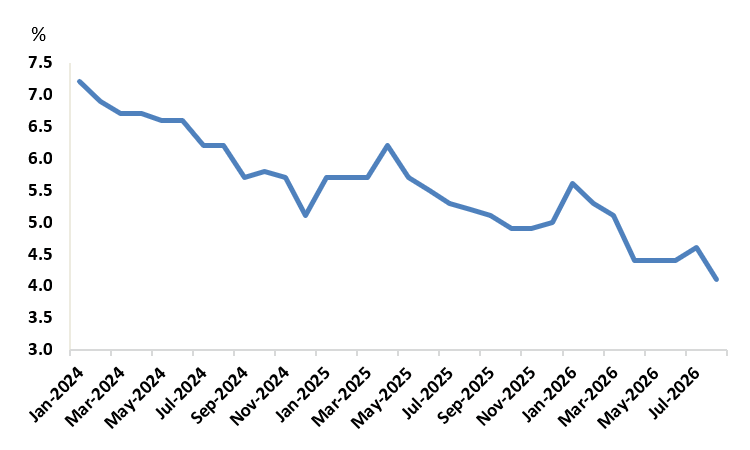
The US consumer has repeatedly exceeded expectations over the past two years. This earnings season will provide one of the best real-time assessments of whether that strength is beginning to fade. Consumer discretionary companies, retailers, travel firms, and payment networks will offer insight into spending patterns across income cohorts. Investors will watch carefully for signs that households are becoming more selective, particularly as personal savings continue to normalize and borrowing costs remain elevated (Chart 1).
The divergence between high-income and lower-income consumers could be especially important. Premium brands and experiences have generally held up well, while more value-oriented segments have experienced greater pressure. Any evidence that spending weakness is broadening is likely to raise concerns about the sustainability of economic growth heading into year-end.
Chart 1: US Personal Saving Rate (as a % of Disposable Personal Income)
Bottom Line
All said, the early results from financials support a constructive view of the earnings backdrop, but it is still too soon to draw conclusions about the broader market.
For now, we remain bullish on risk, but increasingly selective about how that risk is taken. Elevated valuations and higher bond yields have raised the bar for further outperformance. This supports a tilt toward quality companies with durable earnings and strong balance sheets through ZUQ (BMO MSCI USA High Quality Index ETF). Investors looking for continued participation in US equities while guarding against downside risks, can do so via buffered strategies such as ZOCT (BMO US Equity Buffer Hedged to CAD ETF – October).
Macro Regime Call
Current macro regime: Reflation – stronger than expected growth + stickier inflation pressure
Policy regime: Neutral/Hawkish (Monetary) and Neutral/Dovish (Fiscal)
Market regime: Cautiously bullish
Risks to call:
- Rapid rise in rates triggers defensive market behaviour.
- Demand for AI slows considerably.
- Inflation pressures deepen.
Portfolio Strategy
a.) Higher yields and elevated stocks: As we alluded to in the lead article this week, we’re expecting the tension between higher yields and buoyant equities to be resolved in the coming weeks. We got a sense of what this looks like last week as AI/tech stocks sold off on concerns over the debt profile of a prominent neocloud firm (CoreWeave) which led to a bid in US duration.
But the CoreWeave episode speaks to a theme that we feel is shifting when it comes to AI infrastructure. Indeed, we get the sense that the market may be less willing to reward higher levels of spend relative to quarters past. That reflects two factors: the increased reliance on debt to finance spending, and the potential lack of revenue stability for frontier labs (used to support parts of the AI infrastructure build-out).
Again, this supports the view that the risks have become asymmetric and that investors should look at hedging against downside risks to US equities and the AI theme in general from here.
b.) Potential AI hedges: If risks do arise to the AI theme, then we see potential hedging opportunities from the following…
- USTs (especially further out the curve)
- CAD equities
- US healthcare and staples
- Select Latam equities.
c.) Alberta referendum: There’s going to be a lot of noise, but here is what you need to know…
- Today’s vote is a referendum on whether to have a binding vote on separation.
- The latest polls have remained at over 70%.
Even if the vote is in favour of holding a binding vote on separation, there is a lot of legislative leeway that determines whether the question of independence is “clear enough” and whether a simple majority voting in favour of separation is a “clear majority”. Also, even if Alberta were in favour of leaving Canada, negotiations would take years and would need to involve other provinces and Indigenous nations before being finalized.
A simple vote on wanting to separate doesn’t automatically mean a province gets to leave. So no, we’re not worried about the impact to Canadian securities and assets from the vote.
d.) Other important items for this week:
- CAD CPI (for September) as well as the Autumn edition of the BoC’s quarterly surveys are out today. The inflation number should push headline above 3% due to energy costs, but we don’t expect to see the same degree of breadth when it comes to price pressures as we have seen in the US.
- For the BoC’s surveys, pay particular attention to whether higher for longer energy prices are leading survey respondents in the business and household sectors to raise their expectations for inflation in the years ahead. That could impact market pricing for the October and December BoC dates (which are currently at 8bps and 24bps).
- US earnings season continues with the big names reporting this week including Netflix, Tesla, Meta and IBM.
- The preliminary PMI reports for the US, Eurozone and UK will be released on Friday.
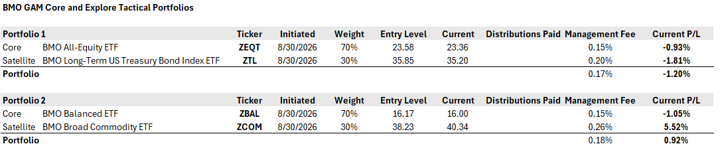
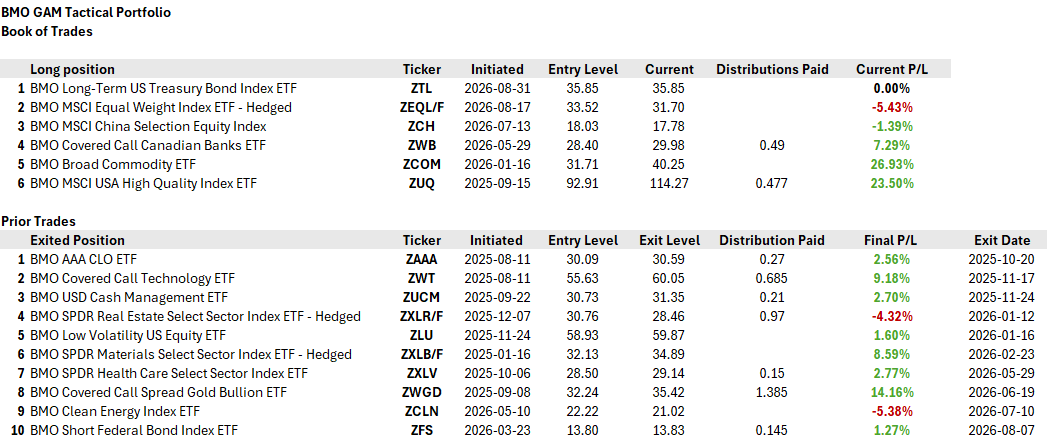
e.) Book of Trades + Core and Explore Portfolios: No changes to the portfolios this week.
Updated Performance of our Strategic Portfolios
Table 1 – BMO Macro Regime Model Portfolio Performance

Table 2 – BMO Tax Efficient Model Portfolio Performance

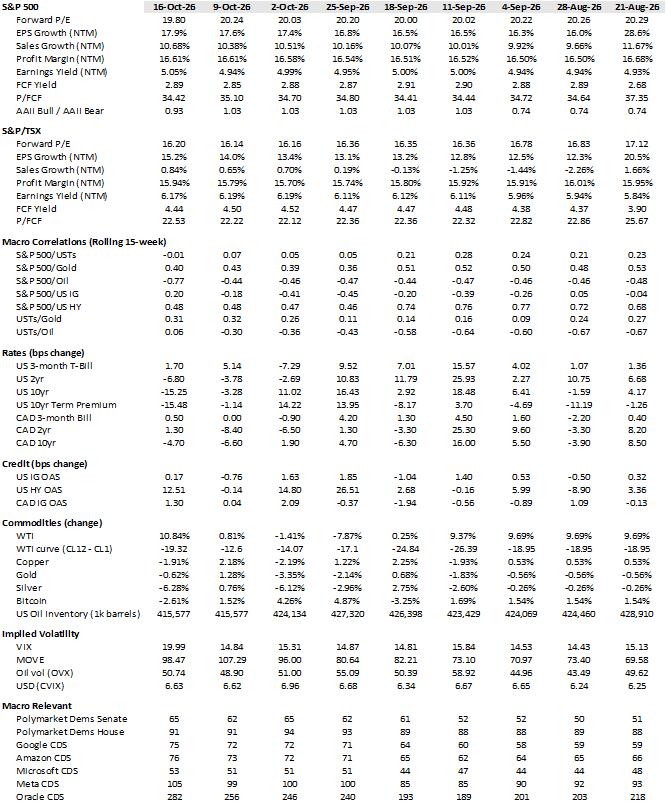
Weekly Macro Table