Weekly Basis Points - Sovereign Risks Support Gold Over Long Term
September 14, 2026
- Gold ETF demand broadened in August as North American and European investors returned alongside continued Asian buying.
- The investment case is widening beyond inflation and monetary policy, with fiscal and currency-policy uncertainty becoming more relevant to gold demand.
- We remain constructive on strategic exposure, but stronger futures positioning argues for maintaining exposure rather than chasing the rally.
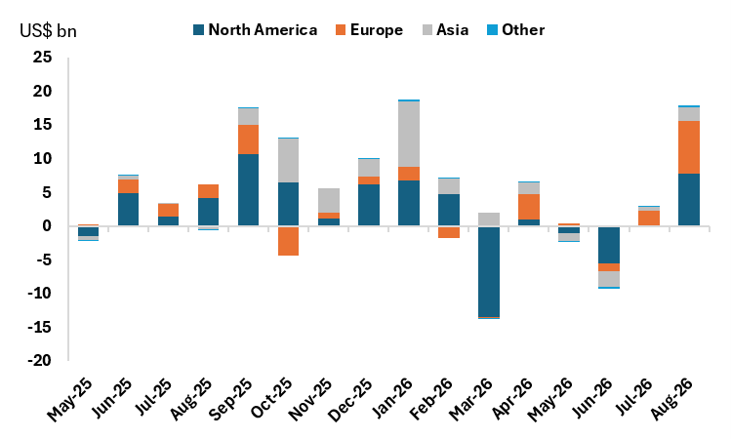
Gold finally delivered the month investors had been waiting for. In August, spot prices for gold rose roughly 10% and global gold-backed ETFs attracted US$18 billion, lifting collective holdings to a record 4,189 tonnes. The headline numbers are impressive, but the more important development is the change in the composition of demand.
Chart 1 – Global Gold ETF Flows by Region
Source: BMO GAM, World Gold Council, Bloomberg
Earlier this year, Asian investors provided the strongest support for global gold ETF flows. August marked the return of North American and European demand without a corresponding retreat from Asia. Chart 1 captures that shift. North American flows accelerated, attracting US$7.7 billion. European demand extended its July rebound, adding US$7.9 billion, while Asian investors remained net buyers, contributing US$2 billion. In our view, that broadening strengthens the investment case because gold is no longer relying as heavily on one region to sustain the allocation trend.
The timing of the flows is equally revealing. North American demand was modest in early August before accelerating sharply during the week of August 17, when more than half of the region’s monthly inflow arrived in five trading days. That shift coincided with growing concern around long-term yields, fiscal sustainability and intervention in the US Treasury market. In China, falling local government bond yields and a range-bound equity market improved bullion’s relative appeal. The catalysts differed, but the conclusion was consistent: investors wanted more exposure to an asset that carries neither sovereign liability nor issuer risk.
These developments do not replace inflation, real yields or the US dollar as drivers of gold. They expand the range of risks against which investors may want protection. Gold has no issuer and carries no sovereign liability, giving it a distinct role when uncertainty originates within government balance sheets or the policy framework supporting currencies and sovereign bonds. At the same time, gold’s move through key technical levels attracted additional tactical demand. These forces are not mutually exclusive. Policy uncertainty can strengthen the strategic case for gold, while positive price momentum determines how quickly investors act on it.
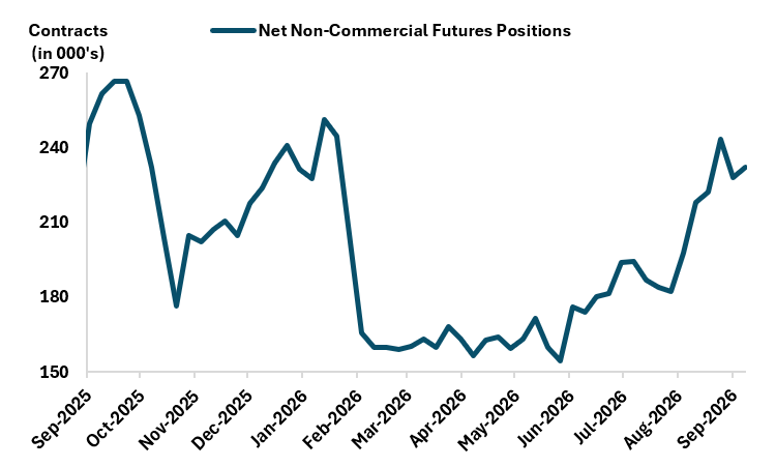
Meanwhile, positioning tells the tactical side of the story, and it argues for discipline. Chart 2 highlights that COMEX net non-commercial futures positions recovered materially through the summer and returned toward the upper end of their one-year range by early September. The improvement in futures positioning alongside ETF inflows shows that conviction strengthened across both investment channels. ETF holdings capture the return of allocated capital, while futures positioning reflects greater tactical participation. Together, they confirm that August’s advance was supported by more than one type of investor. When both are elevated, the risk-reward becomes less favourable - upside surprises get absorbed less efficiently, while a hawkish repricing or dollar squeeze has more crowded positioning to work through on the way down.
Chart 2 – COMEX Net Non-Commercial Futures Positions
Source: BMO GAM, COMEX, Bloomberg
Taken together, the gold story has become more balanced. A hawkish Fed and a firmer US dollar remain credible near-term risks, particularly after a strong run. However, record ETF holdings, renewed Western demand, and persistent concerns about fiscal credibility provide a more durable foundation for strategic exposure. We remain constructive on gold as a strategic portfolio diversifier. ZGLD remains the cleaner bullion expression, while ZGD and ZJG offer equity-linked upside if investment demand continues to broaden.
Macro Regime Call
Current macro regime: Reflation – stronger than expected growth + stickier inflation pressure
Policy regime: Neutral/Hawkish (Monetary) and Neutral/Dovish (Fiscal)
Market regime: Cautiously bullish
Risks to call:
- Realized earnings disappoint relative to expectations.
- Geopolitics lead to another commodity shock.
- Inflation pressures deepen.
Portfolio Strategy
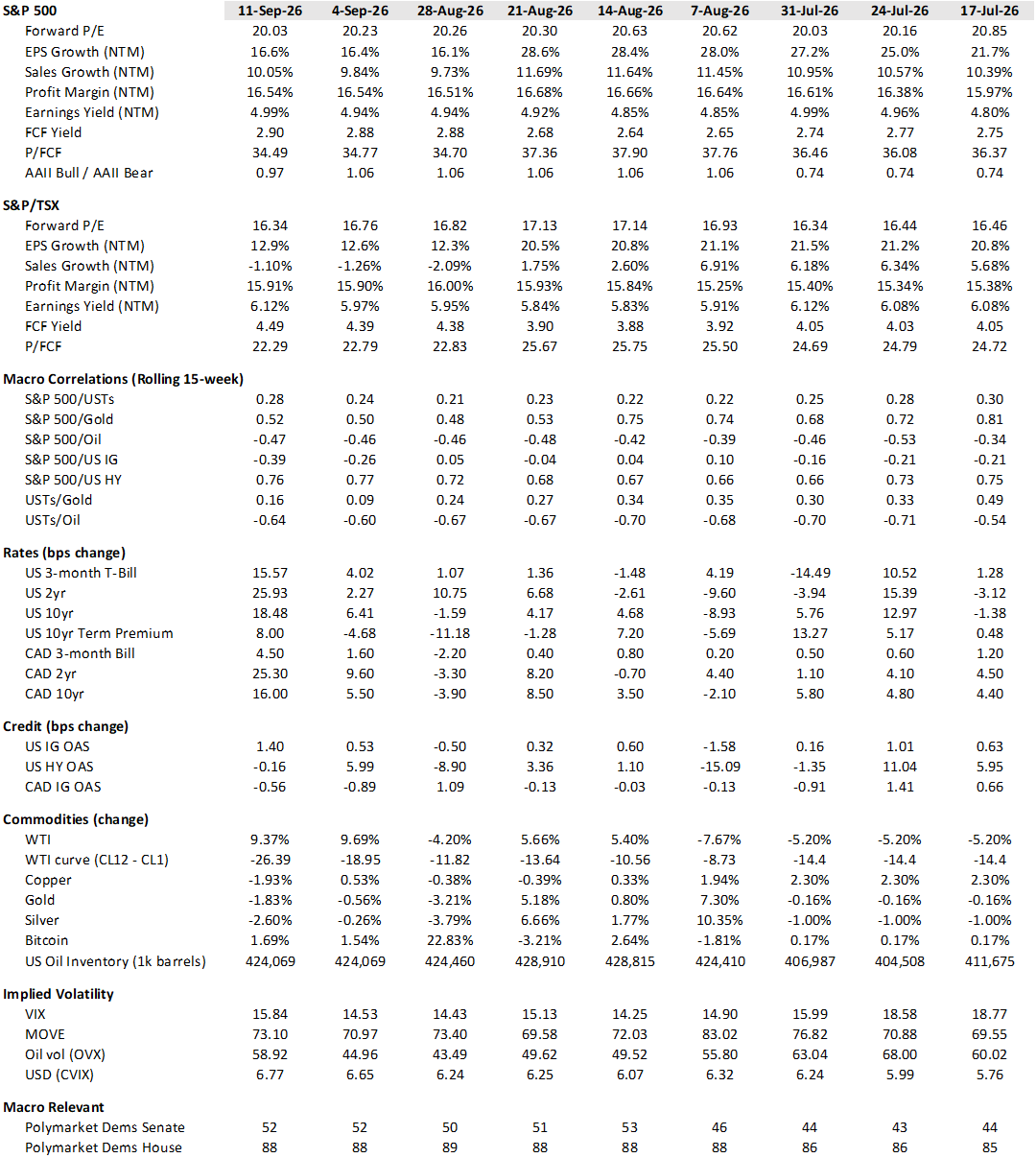
a.) US FOMC (Wednesday): This will be the marquee event of the week. The 25bps hike that markets were not pricing two weeks ago is now the base case. Hotter-than-expected core CPI print last week, and hawkish Fed communication have pushed hike odds to 88% as of Friday, cementing what would be the first increase of this cycle.
The updated projections should provide the first signal of what comes next. A divided set of projections would point to a higher bar for follow-up moves and leave policy more dependent on incoming data. The key will be Warsh’s framing. If he reinforces the case for further tightening, the front end and the US dollar should remain supported, with duration-sensitive assets under pressure. If he emphasizes optionality and avoids endorsing another hike, markets may treat Wednesday as a recalibration rather than the start of a tightening cycle.
b.) Upcoming central bank decisions:
- Bank of England Rate Decision (Thurs): In the UK, CPI data lands Wednesday morning – one day before the decision. The Bank of England is expected to leave rates unchanged on Thursday at 3.75%. With inflation risks rising against soft domestic demand, the vote split will matter more than the decision. A larger hawkish minority would put a November hike firmly in play.
- Bank of Japan Rate Decision (Fri): The Bank of Japan is widely expected to raise its benchmark rate by 25 bps to 1.25% as price pressures broaden and yen weakness persists. The more important event will be post-decision press conference, and we will be paying attention to the signals on the pace of hikes further ahead.
c.) For the coming week:
- Canada CPI (Mon)
- UK CPI (Wed)
- US Retail Sales (Wed)
- Eurozone CPI (Thurs)
- Japan CPI (Fri)
d.) ‘Core and Explore’ portfolios: It has been two weeks since we launched two portfolios. In the first, we paired our ‘all equity’ ETF (ZEQT) with an ETF that tracks the long end of the US treasury curve (ZTL). In the second, we have paired our ‘balanced’ ETF (ZBAL) with our commodity ETF (ZCOM). Please see the updated performance tables below.

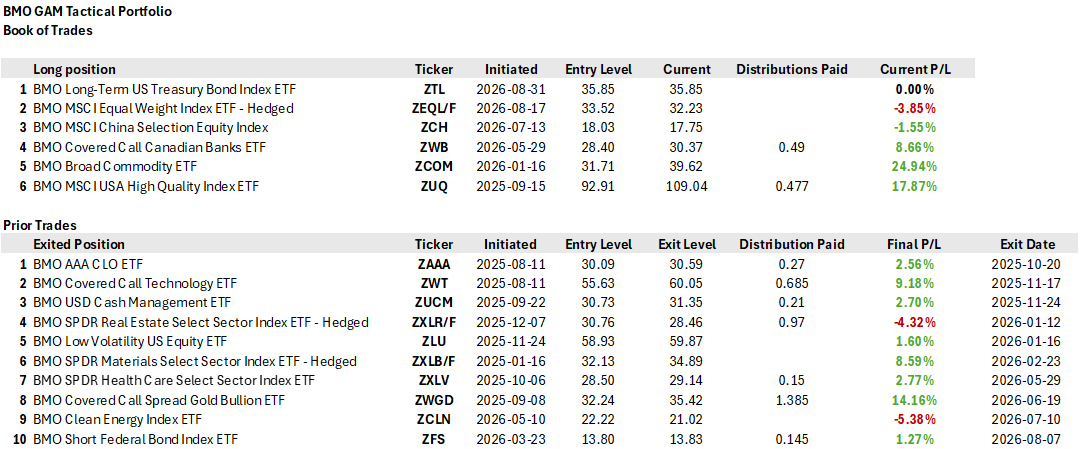
Updated Performance of our Portfolios
Table 1 – BMO Macro Regime Model Portfolio Performance

Table 2 – BMO Tax Efficient Model Portfolio Performance

Source: BMO GAM
Weekly Macro Table