Weekly Basis Points - The Real Story Behind Elevated US Treasury Yields
July 13, 2026
Summary points:
- The recent rise in US Treasury yields is about real rates, not energy prices. Since March, higher real yields have accounted for virtually all of the increase in nominal yields, while inflation breakevens have declined.
- Markets are repricing the Fed’s neutral rate higher. Stronger growth expectations – driven by AI-related investment and a more resilient economy – are leading investors to expect policy rates will need to remain higher for longer.
- Stay cautious on duration. Until growth weakens or the Fed turns more accommodative, real yields are likely to remain elevated, favouring floating rate and option income strategies over long duration Treasuries.
Over the past month, several commentators have argued that elevated US Treasury are inconsistent with the recent decline in energy prices. We think that interpretation misses what is actually driving nominal rates at this juncture.
The simplest way to illustrate this is to break down the nominal US 10-year yield into its components – the 10-year real yield and the 10-year inflation breakeven yield. Since the conduit between energy prices and nominal yields is the inflation breakeven yield, it stands to reason that breakevens should also be the primary driver of nominal yields.
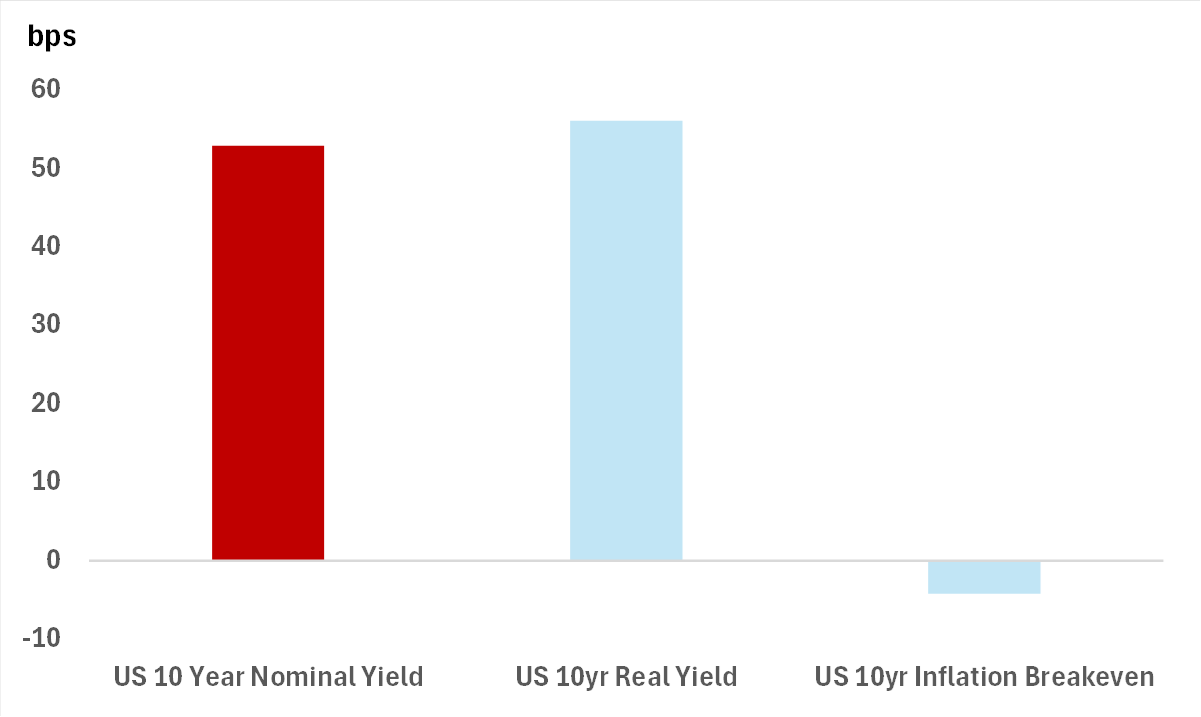
But that hasn’t been the case. While the nominal 10-year yield (currently at 455bps) has increased by 52bps since the beginning of March, 10-year breakevens have moved lower by 5bps. Implicitly, that means that 10-year real yields have done all the lifting and moved higher by 57bps.
The implication is straightforward: this isn’t an oil story. Instead, it’s a real-rate story – which means that investors are repricing growth and monetary policy (not gasoline prices).
Chart 1 – Change in US Treasury 10yr Yields by Component
Source: BMO GAM
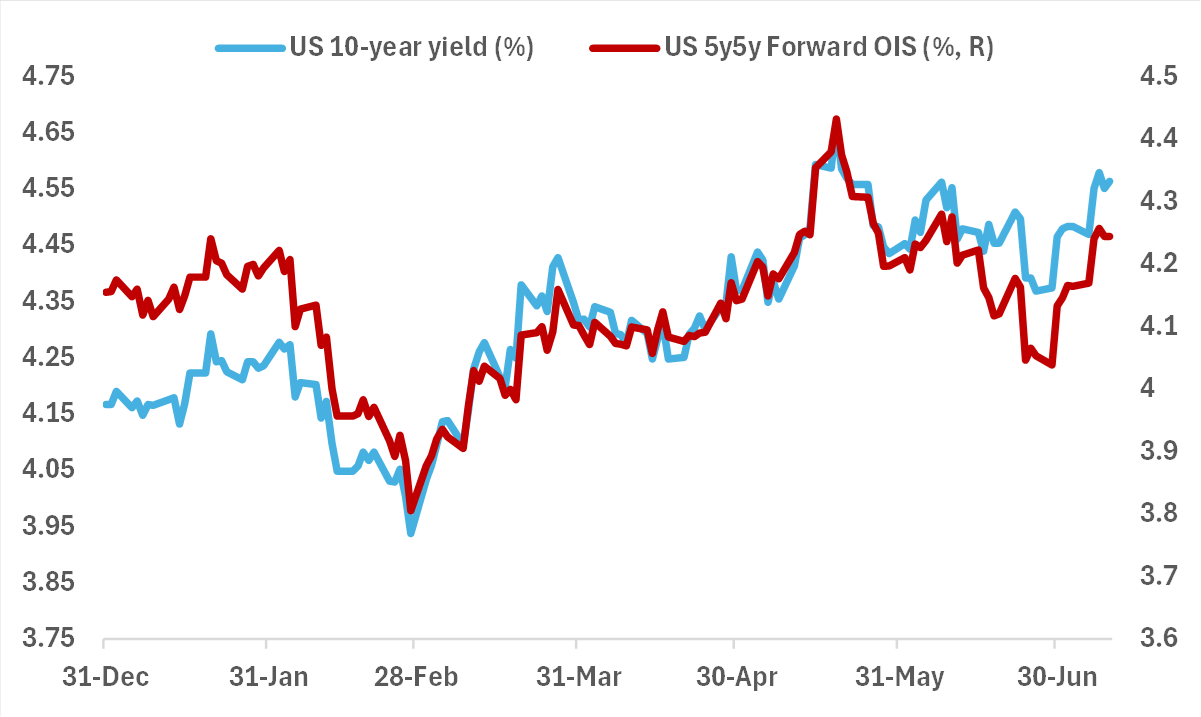
Another way to demonstrate this is the split the 10-year real yield even further into forward Fed policy expectations and the term premium. For the latter, the term premium is only up 3-4bps since early March. But for the former, market expectations of the Federal Reserve’s nominal neutral interest rate (as proxied by US 5y5y forward OIS) have increased meaningfully over the past few months. Said differently, the market now thinks that in order to keep the US economy operating at potential with full employment and stable inflation at target – the equilibrium level of the Fed funds rate needs to be higher from here.
Chart 2 – Market Expectations of the Fed’s Neutral Rate and US Treasury Yields
Why does the market think this is the case? Part of the repricing reflects optimism surrounding AI-related capital spending, which has lifted expectations for potential growth. Another part could be tied to the reassessment of the labor sector, which hasn’t been as soft as originally thought heading into the year.
In any case, the going expectation is that the next move for the Fed is a rate hike – even if the timing remains uncertain. But there are other reasons to expect US Treasury yields to remain elevated here. For one, the competition from corporate supply could lead to some indigestion in the market. For two, the term premium still looks low relative to the amount of Treasury supply in the pipeline, though this will be a more pressing theme in the long end of the curve.
All told, until the market begins pricing weaker growth or a more accommodative Fed, real yields are likely to remain elevated. That is one of the reasons why we exited our TIPS position (via ZTIP) at the end of Q2. Additionally, this also argues against extending duration too aggressively at this point. Income-oriented investors are therefore still better served in floating-rate (including ZAAA) and option-income strategies (covered calls – including ZWB) than long duration Treasuries.
Macro Regime Call
Current macro regime: Reflation – stronger than expected growth + stickier inflation pressure
Policy regime: Neutral/Hawkish (Monetary) and Neutral/Dovish (Fiscal)
Market regime: Cautiously bullish
Risks to call:
- Demand for AI slows considerably.
- Geopolitics lead to another commodity shock.
- Inflation pressures deepen.
Portfolio Strategy
a.) So ‘Hormuz’ is back in our lives again. And the despite the recent uptick in energy prices, broad markets began taking the news in stride towards the end of last week. In retrospect, the tenuous nature of the ceasefire means that markets will need to keep a certain level of geopolitical risk in the price (which implies prompt WTI/Brent in the $70-75 range).
For now, the situation in the Middle East is an inflation story. That could morph into a demand destruction growth if the supply shortage theme becomes more acute (especially if China re-starts its buying of crude to re-stock inventories).
b.) Speaking of China, we are becoming more constructive. Data from last week told us that factory gate prices are expanding at a +4.1% y/y clip. When taken with the rise in industrial profits and manufacturing PMIs, the picture on China’s industrial cycle appears to be shifting. A rise in volumes, better pricing power and higher profits implies that the drag from Chinese manufacturing on global growth is easing at the margin.
The release of GDP and other important data this week will go a long way in affirming our view.
Chart 3 – BMO Macro Regime Model Portfolio Performance
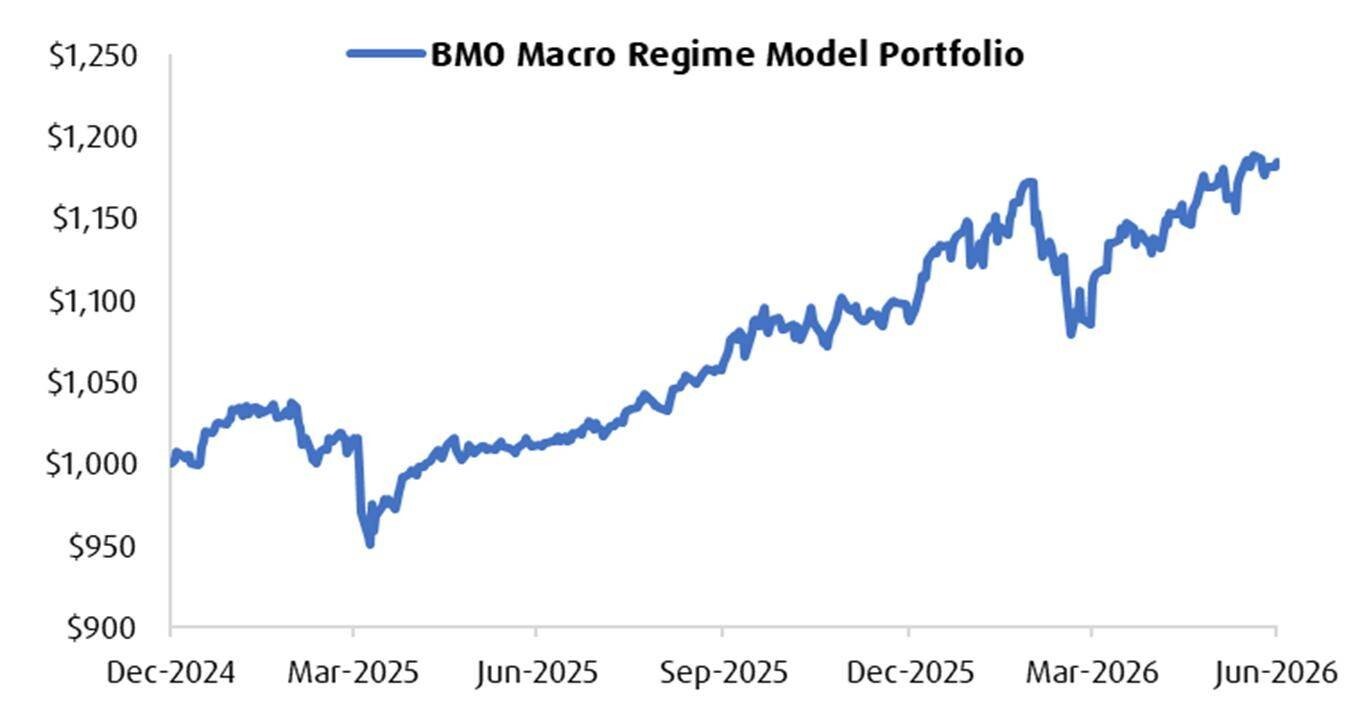
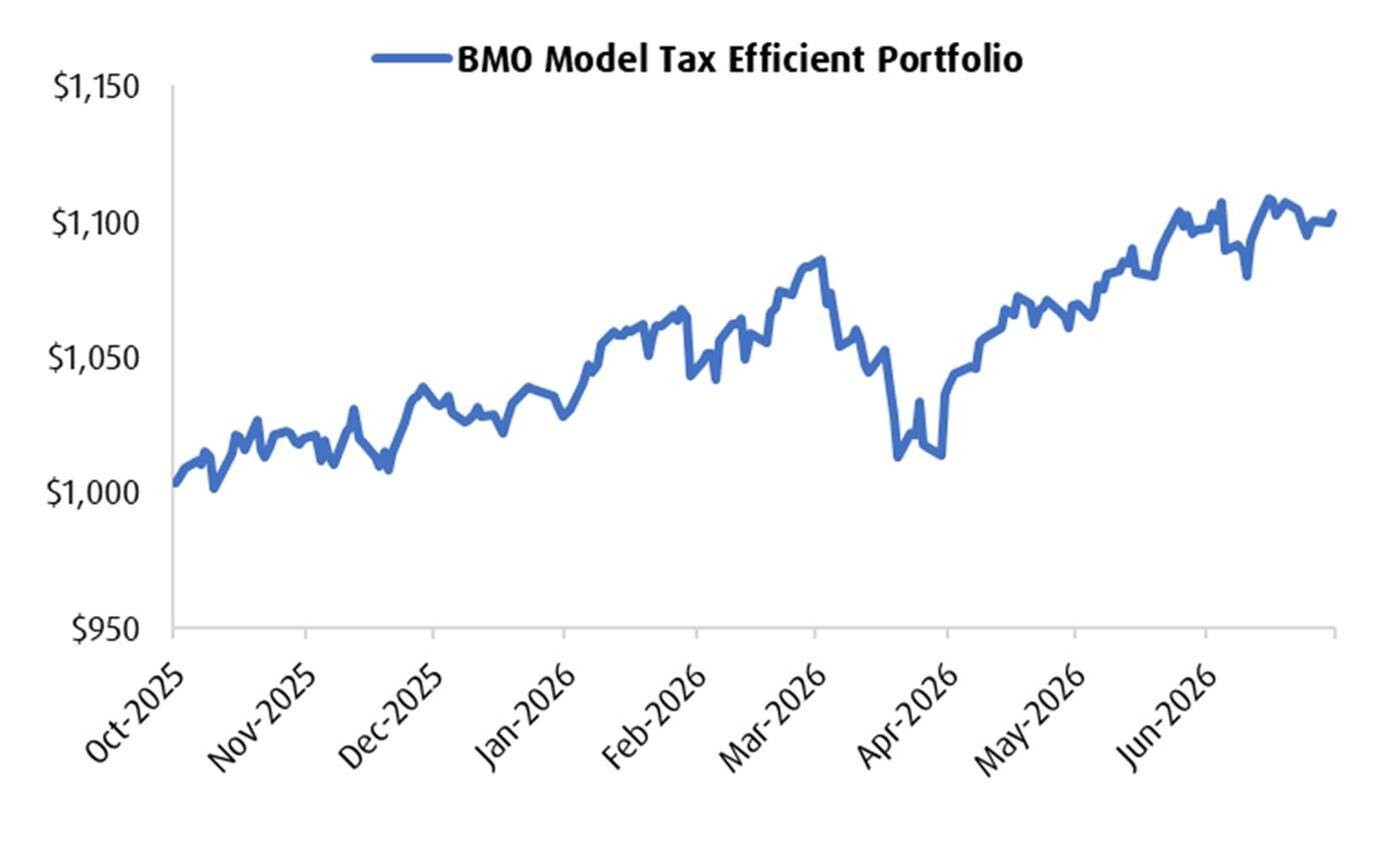
Chart 4 – BMO Tax Efficient Model Portfolio Performance
Key events/data for this week
a.) On the domestic calendar, the Bank of Canada is the main event for the week. The decision/statement should come and go with little fanfare. Instead, our interest will be mostly focused on the updated ‘Monetary Policy Report’ and what it contains with respect to the Bank’s views on the domestic economy.
b.) In the US, there are a few notable data releases and events this week. On Tuesday, the release of the June CPI will be important given the market’s current hawkish read of Warsh and the Fed. Apart from that, Fed Chair Warsh will appear on Capitol Hill to discuss the Semi-Annual Monetary Policy Report.
c.) Earnings season is here. In the US, several dealer banks (JPM, WF, Citi, BofA as well as Goldman Sachs) report on Tuesday while MS reports the day after. Meanwhile, NFLX reports on Thursday.
Outside of the US, ASML reports on Wednesday while TSMC reports on Thursday.
Book of Trades
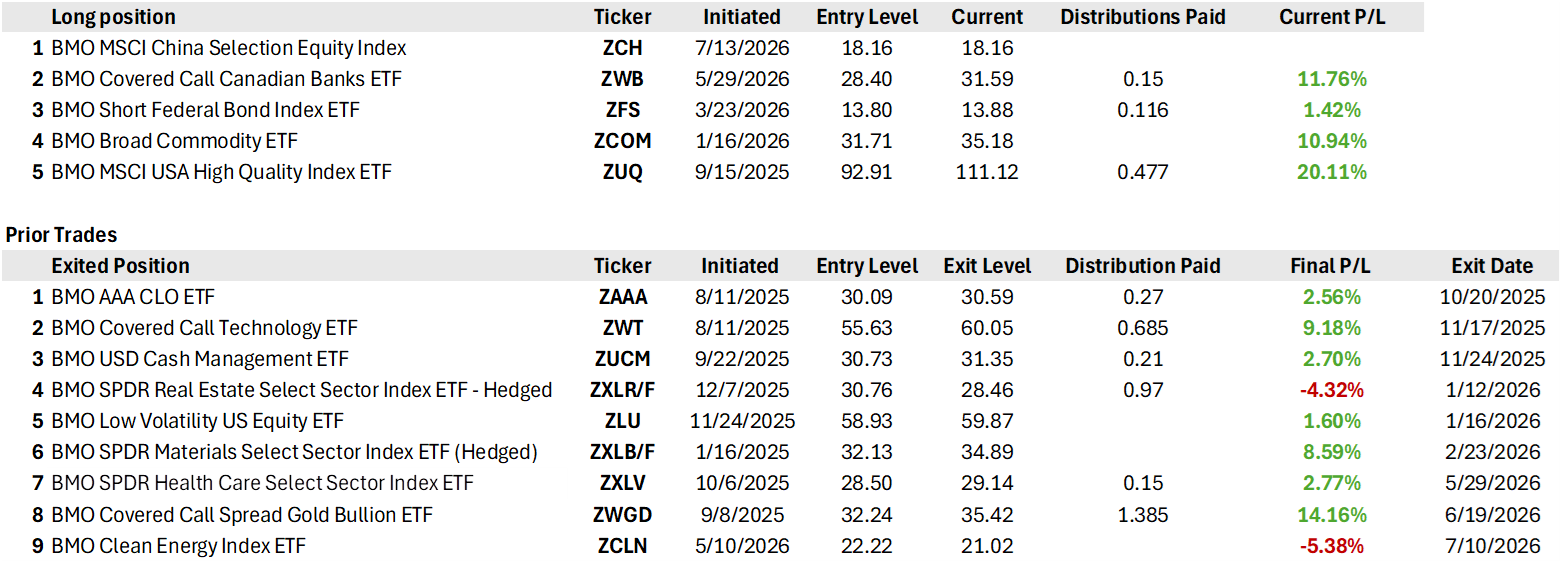
We’re adding a long position in ZCH. Please see the ‘Portfolio Strategy’ section above for more.
We are exiting our position in ZCLN for a loss of 5.38%.