Weekly Basis Points - Without a Supermajority, the Midterms Don’t Matter
October 25, 2026
Summary points:
- The market impact of the US midterms is likely to be limited, as Democrats are unlikely to secure the two-thirds supermajority needed to override presidential vetoes, leaving trade, tariffs, immigration, and AI policy largely unchanged.
- Investors should focus on fundamentals rather than election outcomes, with key drivers remaining earnings, central bank policy, geopolitics, and whether markets continue to reward debt-financed AI spending amid ~5% 10-year Treasury yields; accordingly, we continue to favour low-beta ETFs (e.g., ZOCT and ZPAY) while maintaining an overweight equity allocation.
Sometimes, strategists have a way of looking past risks until the calendar pushes them into view. For instance, the US midterm elections have occupied the periphery of our outlook for months now, and we’re finding it increasingly difficult to look past them given the ongoing hype ahead of the November 3rd election date.
But alas, there is an important reason why we’ve refrained from commenting on the US midterms. We don’t think they will end up mattering much, if at all, to our long-term outlook. The reason is simple: a Democratic Congress would have limited ability to alter the administration’s agenda without presidential support.
Of course, we’re assuming that current polls are correct and that the Democrats are a near-lock to win the House while the odds of a majority in the Senate have risen substantially over the past few months. That puts the odds of a Democrat controlled Congress at about 63%. However, the odds of a Democrat ‘supermajority’ in Congress, which is needed to override any veto from President Trump, are very slim. The Republicans need to retain just four of the incumbent 22 seats that are up for grabs in the Senate to prevent that outcome, which seems easy enough for them to do despite historical levels of unfavourability.
That last point is incredibly salient for understanding how to calibrate going forward. For instance, consider the following issues:
On the trade, tariffs, and immigration, there is little that the Democrats can do. Trump has issued over 280 executive orders on these policies since his second term began, and it stands to reason that this will remain his preferred method of policy implementation for the remainder of his term. Congressional Democrats could attempt to nullify an executive order by passing legislation aimed at neutralizing it, but this would almost certainly be vetoed by Trump.
That also extends to AI regulation. Congressional Democrats could introduce and pass bills centered on AI regulation, but without President Trump’s signature these bills won’t become law. So any risk of increased AI regulation should be faded post the election - not that we’re seeing much of a premium priced in yet anyway.
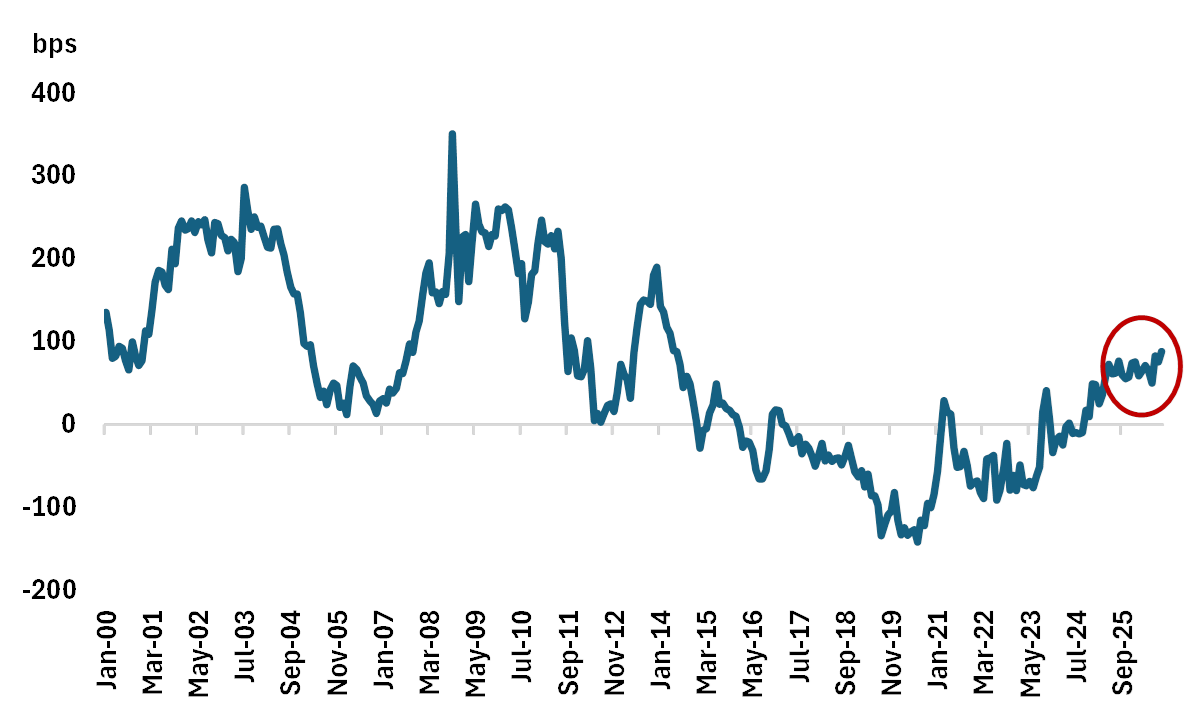
On the budget, we do expect fireworks in the coming years. If history is any guide, there will be strong disagreements on annual appropriations between President Trump and a Democrat controlled Congress. At the very least, that implies risks of government shutdowns and (eventually) continuing resolutions to fund the government as legislative gridlock continues. That should work to curtail incremental fiscal expansion, which should be supportive for US duration at the margin. But even then, markets don’t seem to be pricing in an elevated term premium due to larger deficits. Indeed, the current 10-year term premium is about 90bps, which is well below levels seen earlier this century (see Chart 1).
The debt ceiling is another issue that we’ll be monitoring into next year. The current debt limit imposed on the US Treasury by Congress is US$41.1 trillion and it is likely to become binding at some point in 2027. Again, this could lead to another standoff between the White House and Congress, but pricing this risk is difficult given the uncertain timing.
All told, beyond the typical volatility in the aftermath of the midterms, we don’t see a clear conduit for portfolio construction over the medium-term. Instead, the key drivers are still upcoming earnings, central bank policy announcements alongside geopolitical developments with respect to energy and commodities.
The most important item to watch for now is whether markets will be as keen to reward additional debt-financed AI capex from hyperscalers when US Treasury yields are close to 5% in the 10-year bucket. So far, it doesn’t appear that they are, which is why we continue to like de-risking via low-beta ETFs (including ZOCT and ZPAY) while remaining overweight equities in our portfolios.
Chart 1 – The Current US 10yr Term Premium Doesn’t Suggest Markets are Concerned with Deficits
Macro Regime Call
Current macro regime: Reflation – stronger than expected growth + stickier inflation pressure
Policy regime: Neutral/Hawkish (Monetary) and Neutral/Dovish (Fiscal)
Market regime: Cautiously bullish
Risks to call:
- Rapid rise in rates triggers defensive market behaviour.
- Demand for AI slows considerably.
- Inflation pressures deepen.
Portfolio Strategy
a.) Bank of Canada: There is a lot of cognitive dissonance on the BoC decision week (Wednesday morning).
On one hand, the softish September CPI report should give the BoC more time to assess incoming data. But on the other hand, the results of the quarterly survey plus strong Q3 real activity tracking does imply that the Bank shouldn’t be too relaxed about current policy settings.
Most economists agree that the BoC shouldn’t raise rates this week, but probably will given the comments from Governor Macklem at the IMF meetings in Bangkok that emphasized upside risks to inflation. Why else make those comments ahead of the communications blackout other than to tee up a looming rate hike?
As such, the street has shifted and the market now has the Bank hiking rates this week.
b.) The Federal Reserve: Unlike the BoC, the Fed is expected to maintain its policy rate range between 3.75% - 4.00% on Wednesday afternoon.
We could make a much stronger case for the Fed to be hiking rates at this meeting – given the firm GDP tracking and sticky price pressures. On the former, it’s important to note that recent capex announcements don’t imply any degree of sensitivity to higher yields, which suggests that policy settings might still be a bit too stimulative in the US over the medium-term.
However, we can’t completely disregard the optics of hiking policy rates a week before the midterm elections. We suspect that this is weighing on more than a few FOMC members’ minds this week. As such, the Fed will eschew a rate hike this week and look towards the December meeting instead.
c.) Earnings announcements: These are the five that we’re eyeing closely…
- Microsoft (Wed after close): This is the market’s clearest read on enterprise AI monetization and cloud demand. Keep close watch on Azure growth, AI backlog conversion, and capital expenditure projections.
- Alphabet (Wed after close): We’ll be eyeing Google Cloud growth and margins as well as capex guidance here.
- Amazon (Thurs after close): This is an important read on cloud demand, and consumer activity.
- Eli Lilly (Thurs before open): The leading pharmaceutical readthrough.
- ExxonMobil (Fri before open): The most relevant energy-sector report.
Outside of the US, there are important European banks and energy companies reporting as well as Canadian resource and transport companies.
d.) The key macro narrative: While the fundamentals may remain sound, the issue right now is whether the market is willing to reward additional AI-related capex when yields are elevated. For instance, increased capex projections when US 10-year yields are at 5% could mean something differently than when they were at 4%. We suspect that this is behind the rotation from equities and into bonds of late.
We’ll get a better sense of this once the major hyperscalers report this week.
e.) Other important data/events this week:
- The European Central Bank is expected to maintain policy and administered rates this week. Though price pressures remain a problem, the ECB has already hiked twice in the past four months.
- The first estimate of Q3 GDP is out for the US (Thursday) and the Eurozone (Friday). For the US, the street is expecting a +3.2% annualized print driven by strong household consumption and non-residential investment. In the Eurozone, the annualized print should be closer to 0.8% - a deceleration from the Q2 pace.
- The Bank of Japan is also expected to keep rates on hold on Thursday evening and stick with hawkish communication. Also of note, the forward-looking Tokyo CPI series is out later in the week.
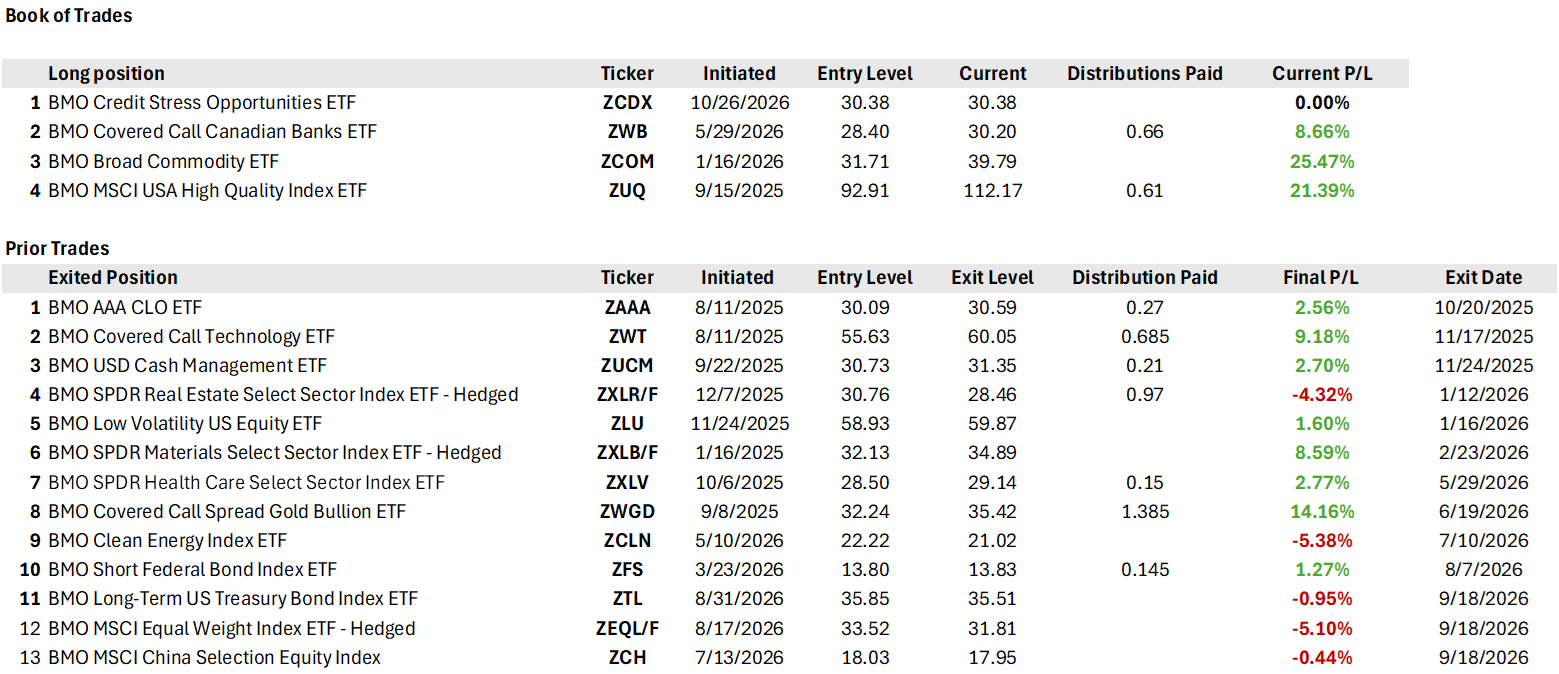
f.) Book of Trades: We’re initiating a new trade and going long ZCDX. We had originally considered this ETF as part of our Q4 portfolio update, but at the time we felt that strong corporate balance sheets should preclude material widening in high yield spreads. That view needs to be updated – not least as US high yield spreads to Treasuries are now wider than they were on Liberation day.
Updated Performance of our Strategic Portfolios


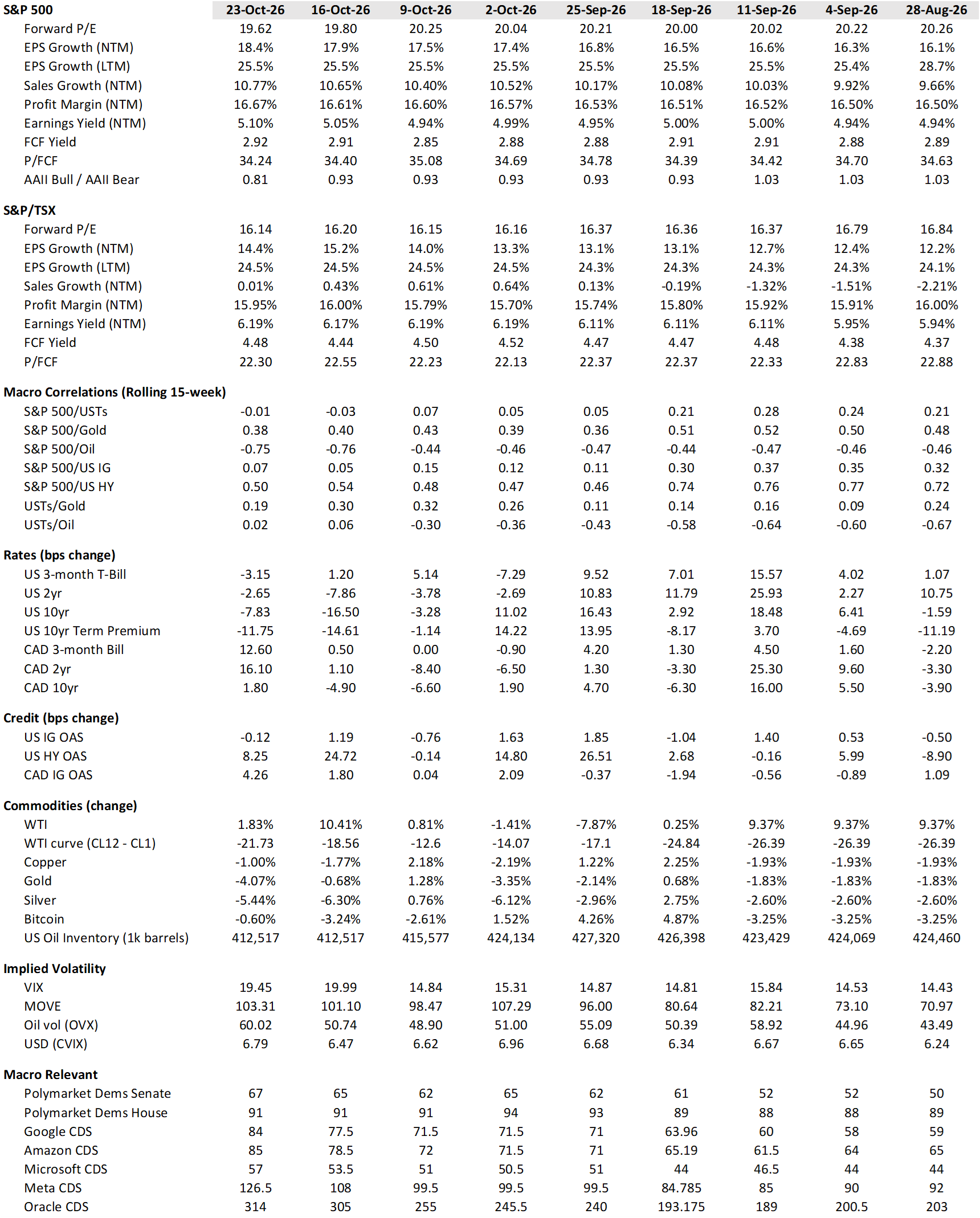
Weekly Macro Table