Top ETF Trades for 2026: Conviction, Context and a Respect for Unpredictability


The end of the year is a special time. The slowing modulation of the markets gives many an analyst time to unplug, which inevitably leads to reflection about what the next year will bring. And as ideas begin to take shape, convictions start to form and a general sense of where the market is headed is reached.
It is almost always a humbling exercise.
For instance, just consider a subset of the important macro/market events from this year:
- The repeated rounds of tariffs and counter-tariffs between the U.S. and it’s largest trading partners (Canada/Mexico/China/EU).
- A massive sell-off in the spring that took the S&P 500 into bear market territory.
- The U.S. toying with the idea of raising taxes on foreign investors (Section 899).
- Inflation remaining above target across many jurisdictions for most of the year.
- Israel and Iran exchanging strikes – with the U.S. also getting involved by attacking Iranian nuclear sites.
- Repeated attacks by the U.S. President on the sitting Federal Reserve (Fed) Chair with the President openly admitting that he’d like to fire the Chair and replace him with someone that is more aligned to his views.
- The U.S. President attempting to remove a sitting Fed board member.
- The longest U.S. government shutdown in history.
- Market concentration remaining high with artificial intelligence (AI) tiptoeing further into ‘bubble’ territory.
If, at the end of 2024, you had given us the above observations for 2025 there is little chance we would have expected U.S, equities to return 15-16% this year. We would have probably gotten the direction on gold right, but almost certainly whiffed on the magnitude of gains this year (at around 60%).
That is why we are going into this exercise clear-eyed and with a sense of trepidation (and maybe a bit of dread). What we can say is that given the current set-up, the below trades are best positioned to serve our readers well as they look to calibrate for 2026. Please note, this is a very different exercise than our portfolio strategy (which will be out in the new year). Instead of constructing a portfolio tailored for a particular investing approach, we are selecting ETF trades that we feel will outperform given the available information on the macro that we have on hand now.
First, some basic assumptions:
- We expect the U.S. economy to grow at trend (1.8-2.0%) in 2026 with inflation remaining above the 2% target for the year. Additionally, the labour sector should remain under some modest pressure which leads the Federal Reserve to cut 1-2 more times in 25 basis-point (bps) increments.
- For Canada, growth is likely to slow from this past year and settle at around 1.4-1.5%. That is still slightly below potential, which implies that inflationary pressures should remain contained. The Bank of Canada is likely done easing for now and talks of rate hikes in late-2026 still feel premature.
- We expect the S&P 500 to rally by about 8-10% in 2026.
- We expect a consolidative environment for Canadian and U.S. yields to start the year, which should give way to upside as the year progresses.
- We see downside risks to U.S. dollar (USD)/Canadian dollar (CAD) over the next three months.
With that out of the way, let’s get started.
Theme #1 – Late Cycle Dynamics Still Favour Quality…
Into 2026, we’d characterize the backdrop for the U.S. economy as one that favours resilience over cyclicality. That is not least given that the current phase of economic expansion feels a bit long in the tooth and the combination of fiscal and monetary measures might lead to an economy that runs hot (i.e., higher prices, moderate growth). In such an environment, we expect investors to prioritize companies with strong balance sheets and stable earnings –important ‘Quality’ characteristics.
Top trades for this theme:
Chart 1 – Average Monthly Returns for Months When Core CPI Is >2%
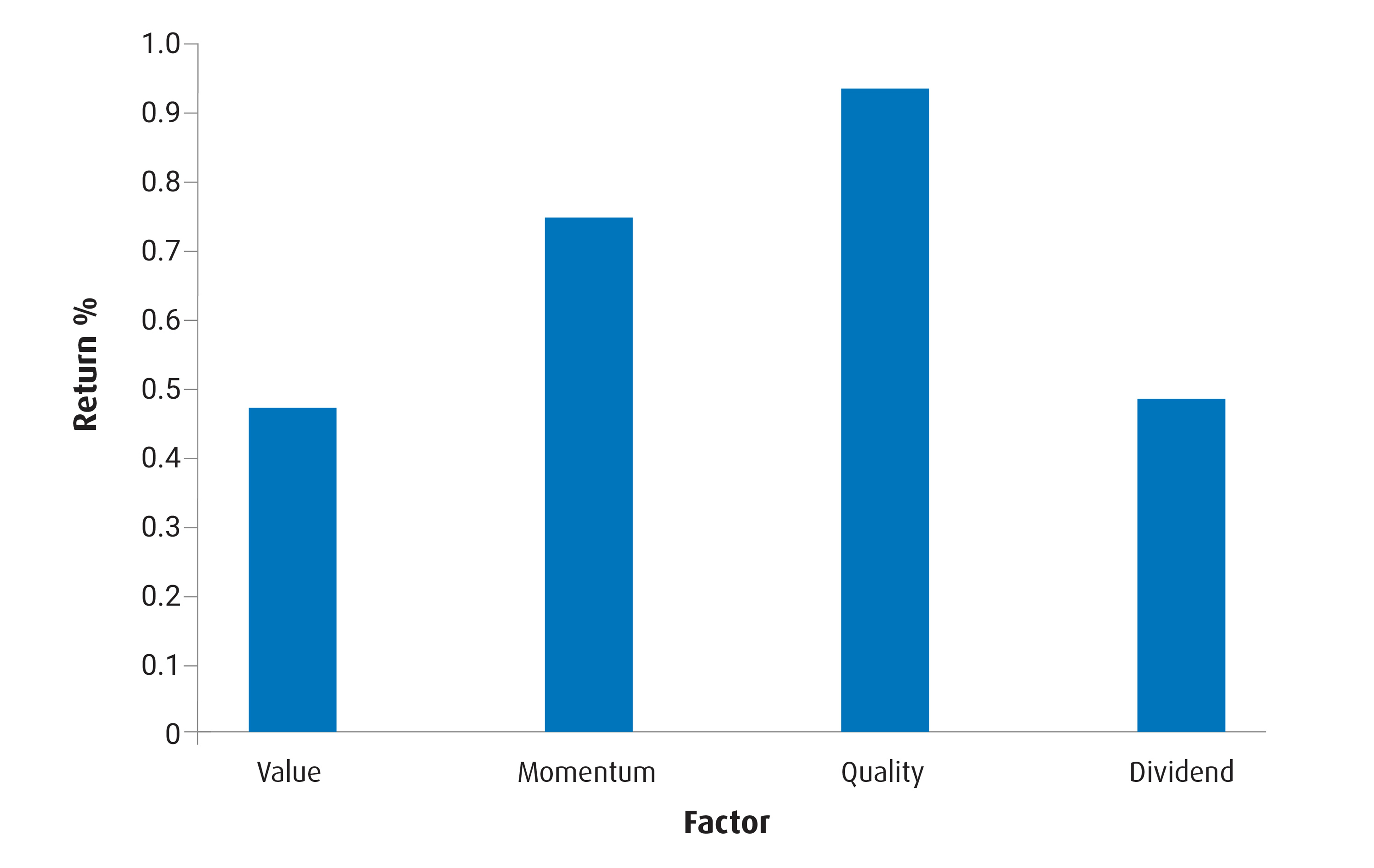
Source: BMO Global Asset Management/MSCI. For U.S. factors; observations go back by 14 years.
Theme #2 – …But with Broader Leadership…
Much of 2025 was characterized by a migration of flows out of the U.S. and into EAFE and EM markets. Given the strength and stability of earnings outside of North America, we expect this theme to continue into 2026.
Aside from valuation (see Chart 2), two other catalysts for this resiliency will be the widespread adoption of new technologies in non-U.S. markets, and fiscal expansion in many countries. Both should work together to improve productivity trends outside of the U.S.
In the emerging world, we see the alignment of different themes working together to attract additional capital to these regions. Indeed, commodity exporters in Latam should continue to benefit from rising prices, while an improving backdrop in China should boost activity in smaller Asian markets.
Top trades for this theme:
Chart 2 – Several International Markets Still Look Cheap Relative to the U.S.
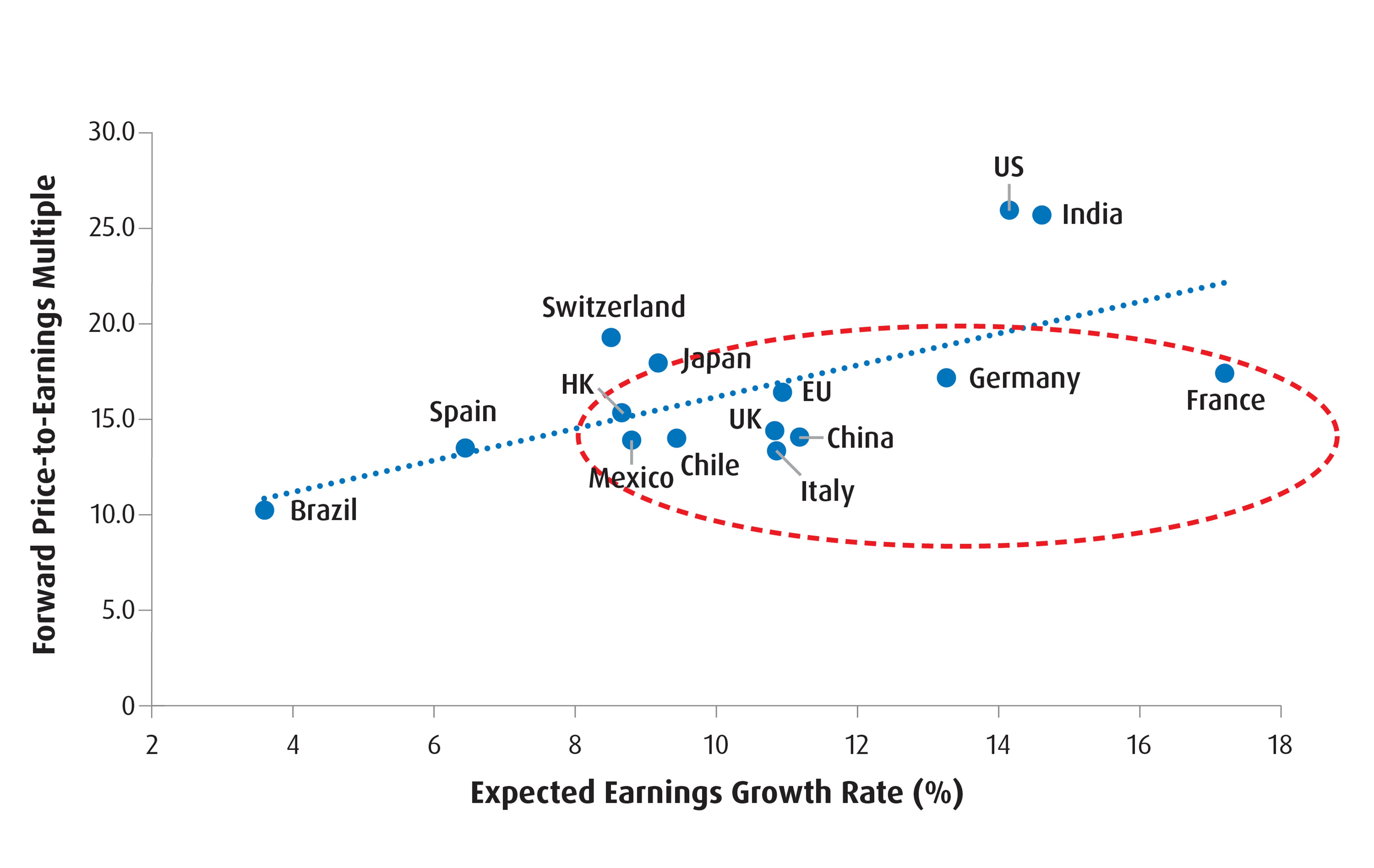
Source: BMO Global Asset Management/MSCI.
Theme #3 – …And a Rotation Away from AI
The delicate rotation away from AI/Tech and into other sectors should continue and will likely engender further uncertainty. However, greater adoption of technology outside of tech/communications sectors will likely shift capital over to cheaper segments of the U.S. market.
Within the tech/communications sectors, we feel active strategies will be better placed to perform. That is largely because the market will become judicious about picking winners and losers in the AI race as increased reliance on debt financing will mean that existing capital structures are more heavily scrutinized. That should portend to a more consolidative environment for broad tech – which supports a product like ZWT given its generous yield.
Outside of tech, two sectors that we feel are best positioned are U.S. healthcare and financials. In particular, healthcare has emerged as an effective hedge against AI-related concerns. The sector is still a bit ‘cheap’ as well, which has also worked to support its performance over the past months.
For financials, we expect demand for loans in the U.S. economy to remain strong – not least as household balance sheets remain in good standing and as valuations remain cheap when compared to other sectors. An additional tailwind comes from regulatory changes that should free up more capital for deployment.
Top trades for this theme:
Theme #4 – Elbows up!
In Canada, we remain constructive on financials but also acknowledge that the market is likely to be one in which alpha can be generated through more active strategies.
Indeed, we continue to like CAD banks. Strong capital positions and the ability to generate revenues outside of traditional retail-based lending means that there are plenty of opportunities for capital deployment in 2026. However, valuation remains a bit of a headwind. As such, we favour a covered call strategy instead of a beta one.
More broadly, without the benefit of a banner year for gold again, we see increased risks for a more volatile market backdrop. Upcoming CUSMA (Canada United States Mexico Agreement) “2.0” talks will bring some chop to the CAD cross-asset space, which implies that there is an opportunity for active ETFs to outperform broad market beta plays.
Top trades for this theme:
Chart 3 – CAD Bank Valuations Are High, Relative to History
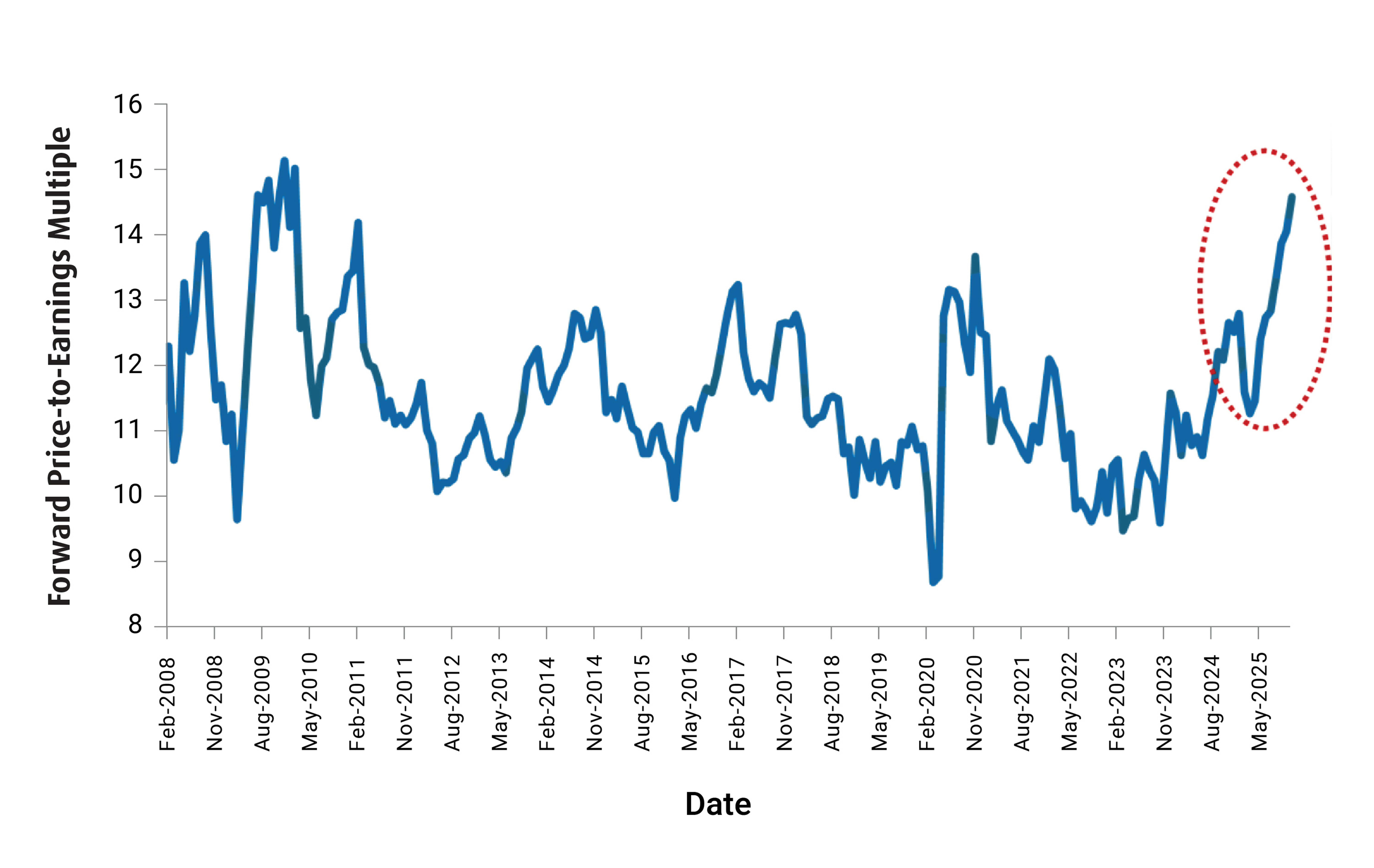
Source: BMO Global Asset Management /Bloomberg.
Theme #5 – Float over Fixed
The setup for fixed income looks suboptimal across most markets next year. Indeed, with central banks in most of the developed world at the end of their respective easing cycles and with term premiums in several countries expected to increase, the risk is skewed towards higher yields in many markets (including Canada and Japan) as the year progresses.
In places where central banks are expected to ease further (the U.S. and U.K.), markets have already moved to price terminal rates close to neutral. For additional cuts to happen, economic conditions would have deteriorate further, which would necessitate shifts into stimulative policy. That is something we don’t envisage happening at this point.
Indeed, with stickier inflation and rising term premium risks, we prefer sub-sovereign floating rate issues to fixed rates in the fixed income sleeve of our portfolios.
Top trades for this theme:
Theme #6 – Stay with Gold, but Don’t Expect the Moon Again
Sorry folks, we aren’t likely to see gold rally by over 60% again in 2026.
Indeed, we expect that demand for jewellery fabrication (which accounts for over 50% of demand in a typical year) will decline, leading to a build in inventories. That will mean that retail/institutional investors (who carried the load in 2025) and central banks (10%) will have to pick up some of the slack.
To be fair, that could happen with inflation set to remain an issue for several central banks. However, that profiles to about a 0-5% pick-up. As such, we like the idea of utilizing the covered call spread strategy for gold to juice returns by an additional 5%.
Top trades for this theme:
Theme #7 – Infrastructure: So What if It’s Boring!
Exposure to global infrastructure funds will give investors access to long duration revenues that are dependent on inelastic demand. What’s more is that there is a strong need for infrastructure in the developed world (mainly upgrades and the push for electrification) and in the emerging world (due to changing demographics).
Top trades for this theme:
Theme #8 – Hedge your Currency (FX) Risks into the Start of the Year
As a rule, we generally abstain from providing actionable FX ideas that last longer than three months. The reason being is that long-term currency risks are generally not rewarded by the market. Indeed, the best practice is to remain nimble and to adjust your exposures frequently.
Into the start of 2026, we’re short USD/CAD – which means that we expect the USD to weaken relative to the loonie over the next three months. This is primarily because we see increased risks that the BoC is likely done easing for this cycle while the Fed may be underestimating the degree of softness in the U.S. labour market and elect to cut a few times next year. Additionally, the market is incredibly short the loonie right now (as gauged by net non-commercial positioning in FX futures). That makes us a bit more doubtful about the prospects of additional CAD weakness from here.
For more market insights and commentary from BMO ETFs, please visit and bookmark Basis Points.
Disclaimers
For Advisor use.
This article is for information purposes only. The information contained herein is not, and should not be construed as investment, tax or legal advice to any party. Particular investments and/or trading strategies should be evaluated relative to the individual’s investment objectives and professional advice should be obtained with respect to any circumstance.
The viewpoints expressed by the author represent their assessment of the markets at the time of publication. Those views are subject to change without notice at any time. The information provided herein does not constitute a solicitation of an offer to buy, or an offer to sell securities nor should the information be relied upon as investment advice. Past performance is no guarantee of future results. This communication is intended for informational purposes only.
Any statement that necessarily depends on future events may be a forward-looking statement. Forward-looking statements are not guarantees of performance. They involve risks, uncertainties and assumptions. Although such statements are based on assumptions that are believed to be reasonable, there can be no assurance that actual results will not differ materially from expectations. Investors are cautioned not to rely unduly on any forward-looking statements. In connection with any forward-looking statements, investors should carefully consider the areas of risk described in the most recent prospectus.
Commissions, management fees and expenses all may be associated with investments in exchange-traded funds. Please read the ETF Facts or prospectus of the BMO ETFs before investing. The indicated rates of return are the historical annual compounded total returns including changes in unit value and reinvestment of all dividends or distributions and do not take into account sales, redemption, distribution or optional charges or income taxes payable by any unitholder that would have reduced returns. Exchange-traded funds are not guaranteed, their values change frequently and past performance may not be repeated.
Distribution yields are calculated by using the most recent regular distribution, or expected distribution, (which may be based on income, dividends, return of capital, and option premiums, as applicable) and excluding additional year end distributions, and special reinvested distributions annualized for frequency, divided by current net asset value (NAV). The yield calculation does not include reinvested distributions.
Distributions are not guaranteed, may fluctuate and are subject to change and/or elimination. Distribution rates may change without notice (up or down) depending on market conditions and NAV fluctuations.
The payment of distributions should not be confused with the BMO ETF’s performance, rate of return or yield. If distributions paid by a BMO ETF are greater than the performance of the investment fund, your original investment will shrink. Distributions paid as a result of capital gains realized by a BMO ETF, and income and dividends earned by a BMO ETF, are taxable in your hands in the year they are paid.
Your adjusted cost base will be reduced by the amount of any returns of capital. If your adjusted cost base goes below zero, you will have to pay capital gains tax on the amount below zero.
Cash distributions, if any, on units of a BMO ETF (other than accumulating units or units subject to a distribution reinvestment plan) are expected to be paid primarily out of dividends or distributions, and other income or gains, received by the BMO ETF less the expenses of the BMO ETF, but may also consist of non-taxable amounts including returns of capital, which may be paid in the manager’s sole discretion. To the extent that the expenses of a BMO ETF exceed the income generated by such BMO ETF in any given month, quarter, or year, as the case may be, it is not expected that a monthly, quarterly, or annual distribution will be paid. Distributions, if any, in respect of the accumulating units of BMO Short Corporate Bond Index ETF, BMO Short Federal Bond Index ETF, BMO Short Provincial Bond Index ETF, BMO Ultra Short-Term Bond ETF and BMO Ultra Short-Term US Bond ETF will be automatically reinvested in additional accumulating units of the applicable BMO ETF. Following each distribution, the number of accumulating units of the applicable BMO ETF will be immediately consolidated so that the number of outstanding accumulating units of the applicable BMO ETF will be the same as the number of outstanding accumulating units before the distribution. Non-resident unitholders may have the number of securities reduced due to withholding tax. Certain BMO ETFs have adopted a distribution reinvestment plan, which provides that a unitholder may elect to automatically reinvest all cash distributions paid on units held by that unitholder in additional units of the applicable BMO ETF in accordance with the terms of the distribution reinvestment plan. For further information, see the distribution policy in the BMO ETFs’ prospectus.
For a summary of the risks of an investment in the BMO ETFs, please see the specific risks set out in the BMO ETF’s prospectus. BMO ETFs trade like stocks, fluctuate in market value and may trade at a discount to their net asset value, which may increase the risk of loss. Distributions are not guaranteed and are subject to change and/or elimination.
The ETF referred to herein is not sponsored, endorsed, or promoted by MSCI and MSCI bears no liability with respect to the ETF or any index on which such ETF is based. The ETF’s prospectus contains a more detailed description of the limited relationship MSCI has with the Manager and any related ETF.
Nasdaq®, Nasdaq 100 Index ®, Nasdaq 100 ®, NDX are registered trademarks of Nasdaq, Inc. (which with its affiliates is referred to as the “Corporations”) and are licensed for use by BMO Investments Inc. The Product(s) have not been passed on by the Corporations as to their legality or suitability. The Product(s) are not issued, endorsed, sold, or promoted by the Corporations. The corporations make no warranties and bears no liability with respect to the product(s).
The Index is a product of S&P Dow Jones Indices LLC or its affiliates (“SPDJI”), and has been licensed for use by the Manager. S&P®, S&P 500®, US 500, The 500, iBoxx®, iTraxx® and CDX® are trademarks of S&P Global, Inc. or its affiliates (“S&P”) and Dow Jones® is a registered trademark of Dow Jones Trademark Holdings LLC (“Dow Jones”), and these trademarks have been licensed for use by SPDJI and sublicensed for certain purposes by the Manager. The ETF is not sponsored, endorsed, sold or promoted by SPDJI, Dow Jones, S&P, their respective affiliates, and none of such parties make any representation regarding the advisability of investing in such product(s) nor do they have any liability for any errors, omissions, or interruptions of the Index.
The Select Sector SPDR Trust consists of eleven separate investment portfolios (each a “Select Sector SPDR ETF” or an “ETF” and collectively the “Select Sector SPDR ETFs” or the “ETFs”). Each Select Sector SPDR ETF is an “index fund” that invests in a particular sector or group of industries represented by a specified Select Sector Index. The companies included in each Select Sector Index are selected on the basis of general industry classification from a universe of companies defined by the S&P 500®. The investment objective of each ETF is to provide investment results that, before expenses, correspond generally to the price and yield performance of publicly traded equity securities of companies in a particular sector or group of industries, as represented by a specified market sector index.
The S&P 500 Index is an unmanaged index of 500 common stocks that is generally considered representative of the U.S. stock market. The index is heavily weighted toward stocks with large market capitalizations and represents approximately two-thirds of the total market value of all domestic common stocks.
The S&P 500 Index figures do not reflect any fees, expenses or taxes. An investor should consider investment objectives, risks, fees and expenses before investing. You cannot invest directly in an index.
BMO ETFs are managed and administered by BMO Asset Management Inc., an investment fund manager and a portfolio manager, and a separate legal entity from Bank of Montreal.
BMO Global Asset Management is a brand name under which BMO Asset Management Inc. and BMO Investments Inc. operate.
“BMO (M-bar roundel symbol)” is a registered trademark of Bank of Montreal, used under licence.